
2025 Homestead Magazine

FREE

Homestead Magazine

ORDER NOW

Search Results for: living with nature

Daring To Be Modern

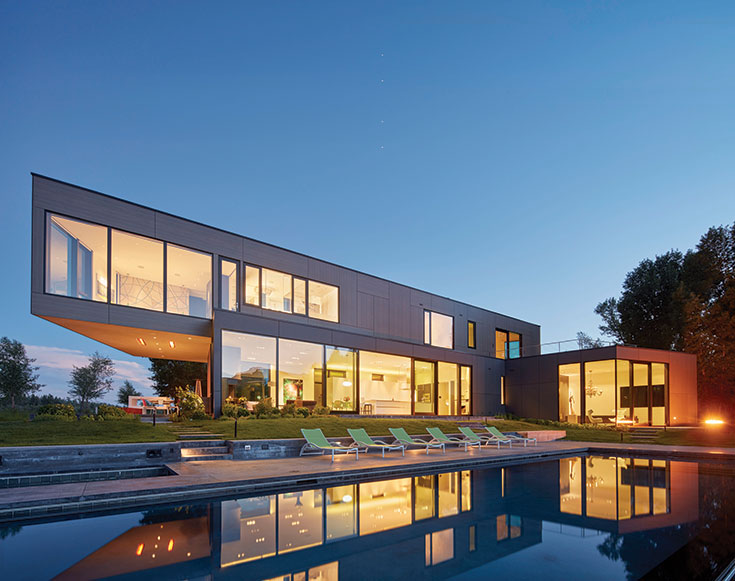
RIVER CHANNEL RESIDENCE: The client wanted the bedroom to be the most important space in this 2016 house. By elevating the room and cantilevering it over the property, Dynia created a space that overlooks a pond, the Snake River and the Grand Teton.

ARCHITECTURE
DYNIA ARCHITECTS
DYNIA.COM

Story By
ELIZABETH CLAIR FLOOD
Photos By
DAVID AGNELLO
Twenty-five years ago, Stephen Dynia established himself as the first architect in this valley with the sole mission of designing contemporary buildings. At the time, most clients imagining living out their romantic frontier dreams hired local architects to design log houses. The mayor even threatened to pass a law requiring future buildings be log in order to preserve Jackson Hole’s character.

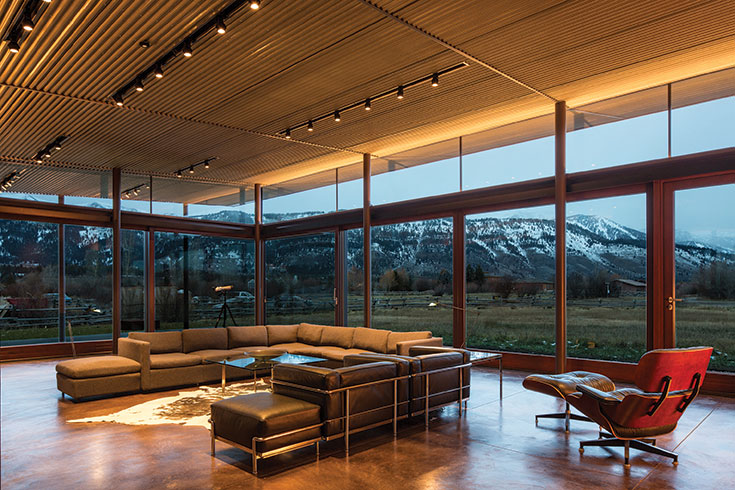
SHOSHONE RESIDENCE: In this 2008 home, the simplicity of mid- century modern furnishings—including two Le Corbusier lounge chairs and an Eames chair—allows the outside in without interrupting the view. Dynia strives to create a seamless connection between interior and exterior space.

Despite the community’s strict, clearly nostalgic affinity for this Western style, Dynia, a schooled and passionate modernist, jumped in, determined to build homes and commercial structures that connected with nature. Tired of corporate politics in his years designing international skyscrapers with the New York office of Skidmore, Owings & Merrill, he looked to reconnect with an architecture of concept and craft learned while studying at the Rhode Island School of Design. Encouraged by his friend and colleague Lisa Carranza, he moved to Jackson in 1993.

A diehard urban dweller, Dynia welcomed a challenge. “It was the contrast of building modern buildings in a rural area,” he says. “It was almost like a dare.”
But not a dare he took lightly. Young and determined, Dynia set about learning everything he needed to know to create enduring architecture in a daunting climate. Awe of the natural beauty and a desire to connect to the land as well as the community informed his designs, which highlighted glass, sleeker lines and rusted patinas.

At first, the going was tough. Despite threats and doubts from locals, this architect relied on trusting clients and his own intuition. A passionate student, Dynia turned the dare into a life passion to understand community, to explore new materials and building techniques and to bring what he loved about modern to the mountain. When he could, he sought out collaboration, connecting with other architects and the community through charettes and lectures on art and design. And, as it turns out, his own research uncovered a noteworthy predecessor. In 1938, Ludwig Mies van der Rohe designed a simple-style steel-and-glass home spanning a creek on the Snake River Ranch. Sadly, the modernist building was never completed; only remnants of a foundation remain today.
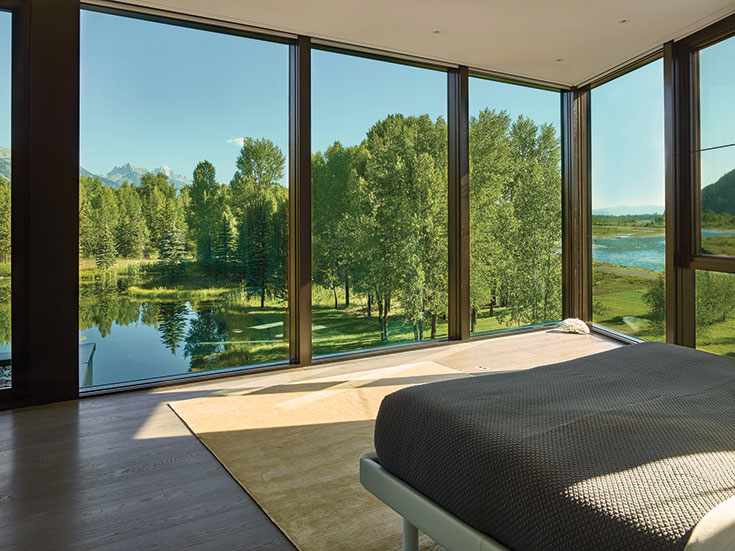
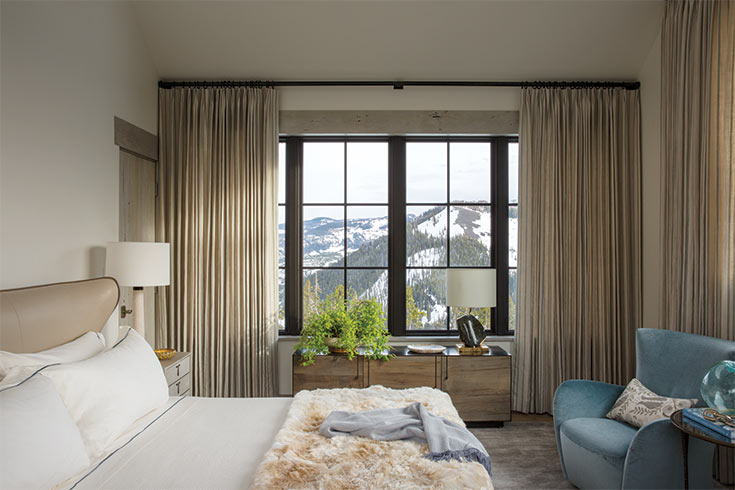
RIVER CHANNEL RESIDENCE: Giant picture windows frame exquisite views from this modern bedroom.

Dynia explored juxtapositions. He pitched rusted metal siding next to more natural materials; contrasted intimate interior spaces with large windows framing vast views. He wowed people with a Kelly home built with the living space upstairs, turned heads with earthy materials and steel at the hip Terroir and Range restaurants, and surprised us with his downtown two-story cubes with rooftop gardens.

Throughout his career, some people remained suspicious. A headline for a newspaper story about his 810 West Housing, a 36-unit mixed-income housing project clad in metal, read: “Art or Pigsty?”
In 2004, Dynia landed his dream job, the lead designer for the 500-seat Center for the Arts theater, a building that would inspire and become a place where the community could explore and experience culture together. More recently, he expanded his business, opening a Denver office, where he has the opportunity to design buildings that engage the public beyond private residences.
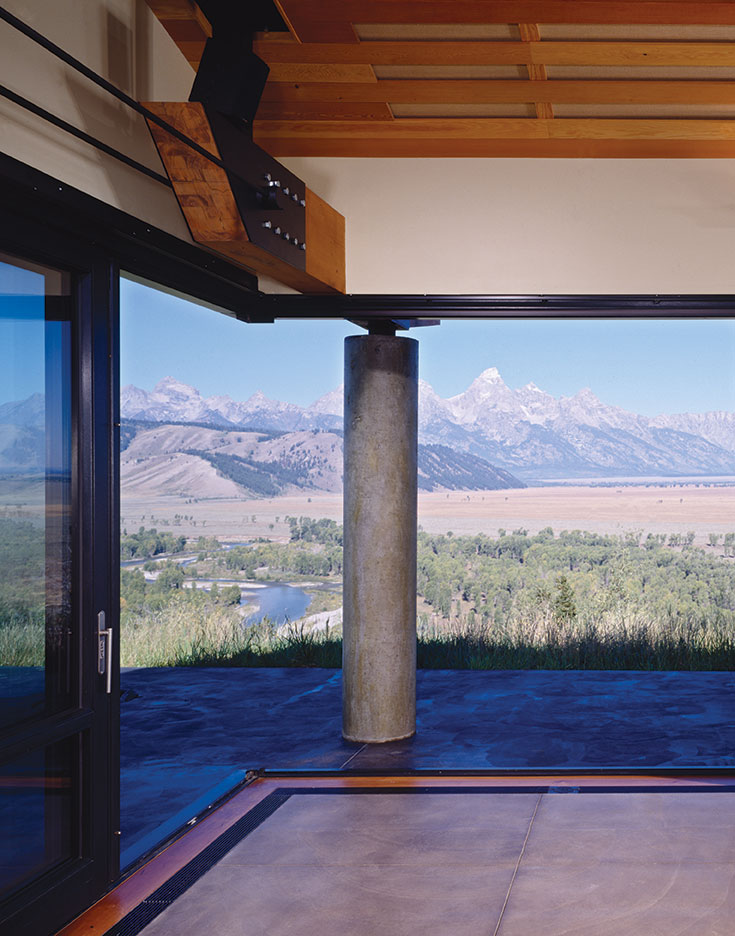
CRAIGHEAD RESIDENCE: The placement of structural pillars on the exterior of this 1999 home allows the windows to span uninterrupted. From a distance, the house reads as a pavilion held up by external columns.

His focus today hasn’t changed. “I’m constantly challenged with the question: What is architecture for Jackson in the 21st century? How do you respect the environment and make a great village?” Dynia Architects now looks to employ green strategies that mitigate architecture’s imposition on the landscape. These include, among other things, denser housing solutions to address the local housing crisis.

The recipient of numerous awards and an active participant on boards and juries throughout the region, Dynia seeks out thoughtful engagement in the culture around him and remains committed to his modernist quest. His latest endeavor is as adjunct professor at the University of Colorado Graduate School of Architecture, where he has the opportunity to share a lifetime of experience designing buildings.

“In all my projects, I want to respect the past while addressing the 21st century, which is constantly presenting new challenges.”
Refuge within a Refuge


Design Associates Architects
designassociatesarchitects.com

Story By
Kelsey Dayton
Photos By
Krafty Photos

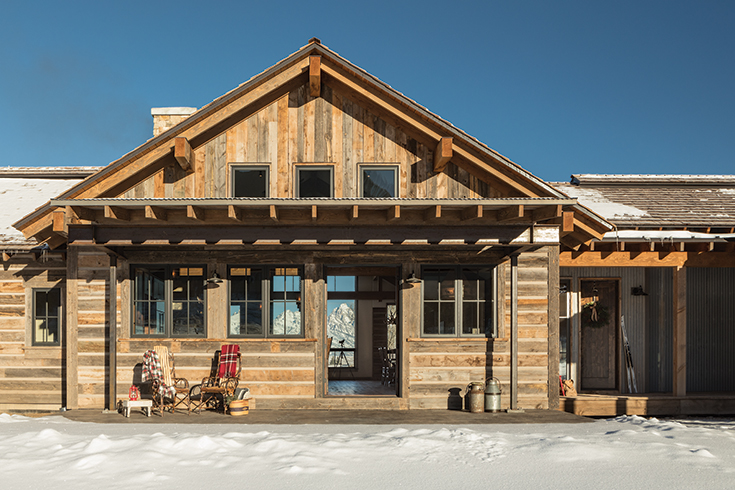
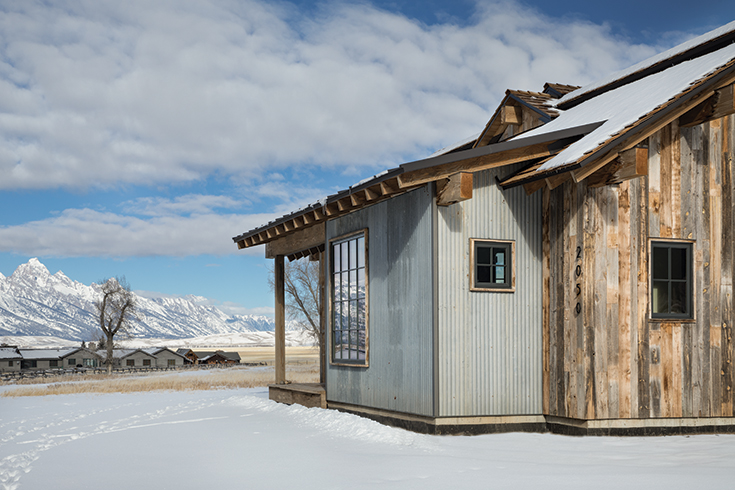
Situated on the edge of the town of Jackson, the National Elk Refuge is home to thousands of elk each winter, as well as bighorn sheep, mountain lions and a smattering of residents who possess some of the few remaining residential inholdings. These lots rarely come on the market, so when the owner of one such property contracted Design Associates to build her new house on her recently acquired lot, architect Chris Lee knew it might be a once-in-a-lifetime opportunity to design an Elk Refuge home. He honored the refuge and its surroundings by blending a log cabin aesthetic with authentic reclaimed materials and clean lines to give an airy and contemporary twist.

“We try not to overdesign,” Lee says. “We try to under-design in a good way, so it feels a little more natural.”

Expansive windows provide views throughout the home. Lee designed the single-level house so that, when doors are open, you can stand at one end of the corridor and enjoy the view at the other end.

Design Associates used reclaimed corrugated metal from old sheds on parts of the home’s exterior. The metal is also used on the roof and complements the reclaimed barnwood that can be seen on both the home’s exterior and interior.

“The views are breathtaking,” he says. “Everyone is so focused on the view up north toward the Tetons, but from her property looking south is just as beautiful. There’s miles of beautiful, open land.”

The homeowner had rented another house on the refuge for years. She loved the home and the location, but never could convince the owners to sell. When a nearby lot came onto the market, she jumped at the opportunity and asked Lee to replicate “all the good stuff” from the house she’d rented and loved—in particular the living room.

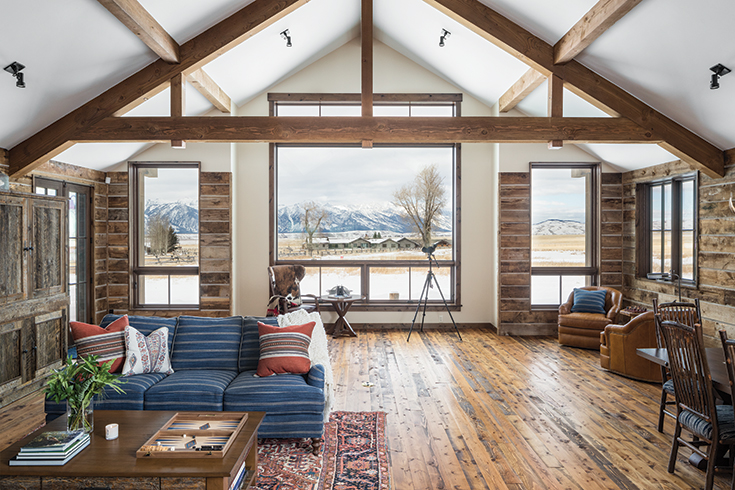
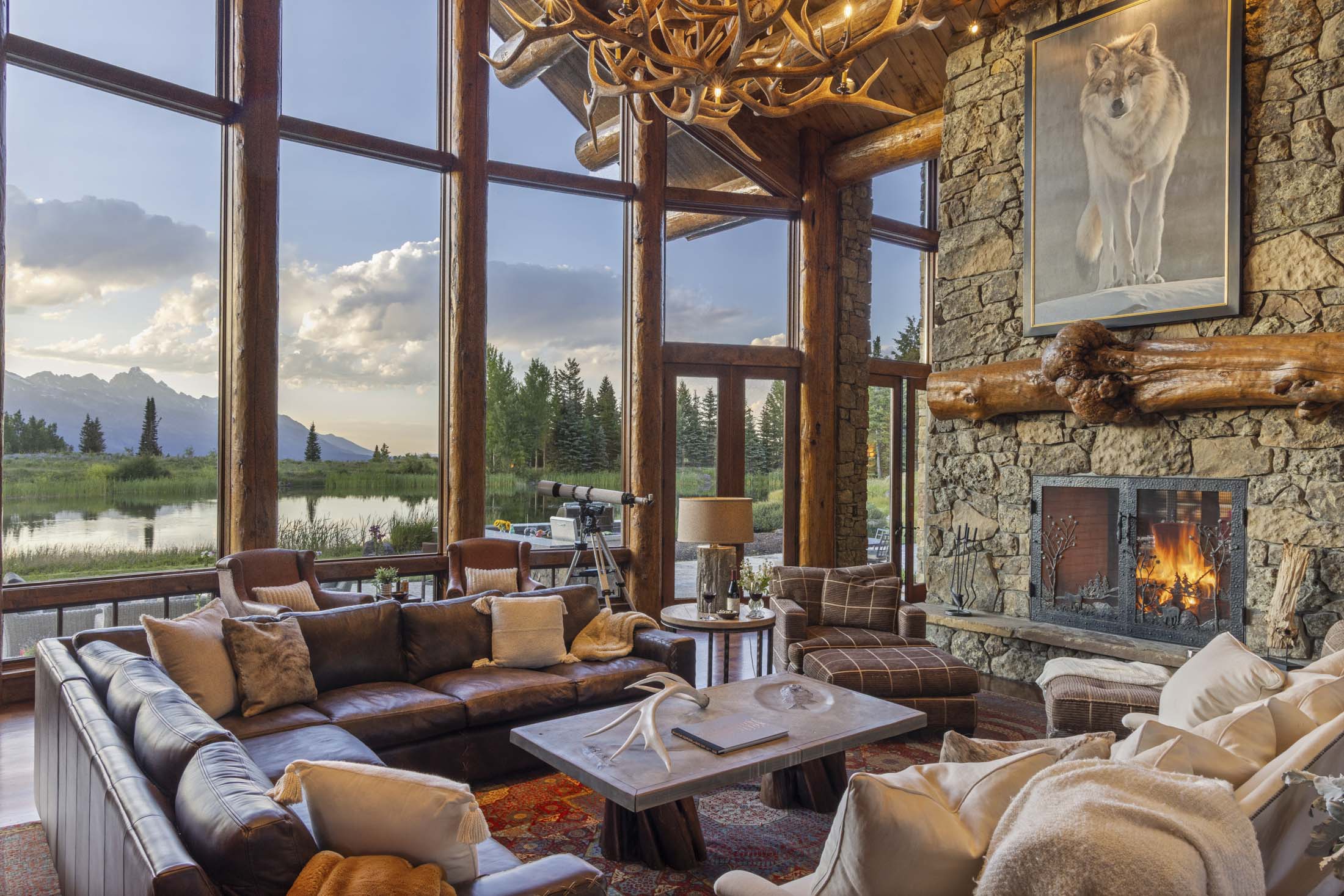
The living room is the heart of the home. Lee replicated the size and open feel of the other house with massive windows and a craggy, rustic-looking fireplace. The entire fireplace is done in stone, which complements the exposed barnwood rafter tails. To combat the heavy feel barnwood can create in old cabins, Lee designed big windows to bring in the light and make the home feel airy.

Planned landscaping will provide privacy without obstructing the view—or diminishing the experience—of the master bathroom, which was designed to bring the outside in. “You are just out there surrounded by nature,” says Chris Lee, of Design Associates.

“We went with some really big windows in all the places that counted,” he says.

The living room connects to an open kitchen designed for multiple people to move around it at the same time. The family loves to cook together, and Lee wanted to make the kitchen an anchor in the home. To preserve the airy feel and light of the vaulted space, he did not include upper cabinetry; instead, he attached a massive working pantry to the kitchen, accessed via an arched doorway.

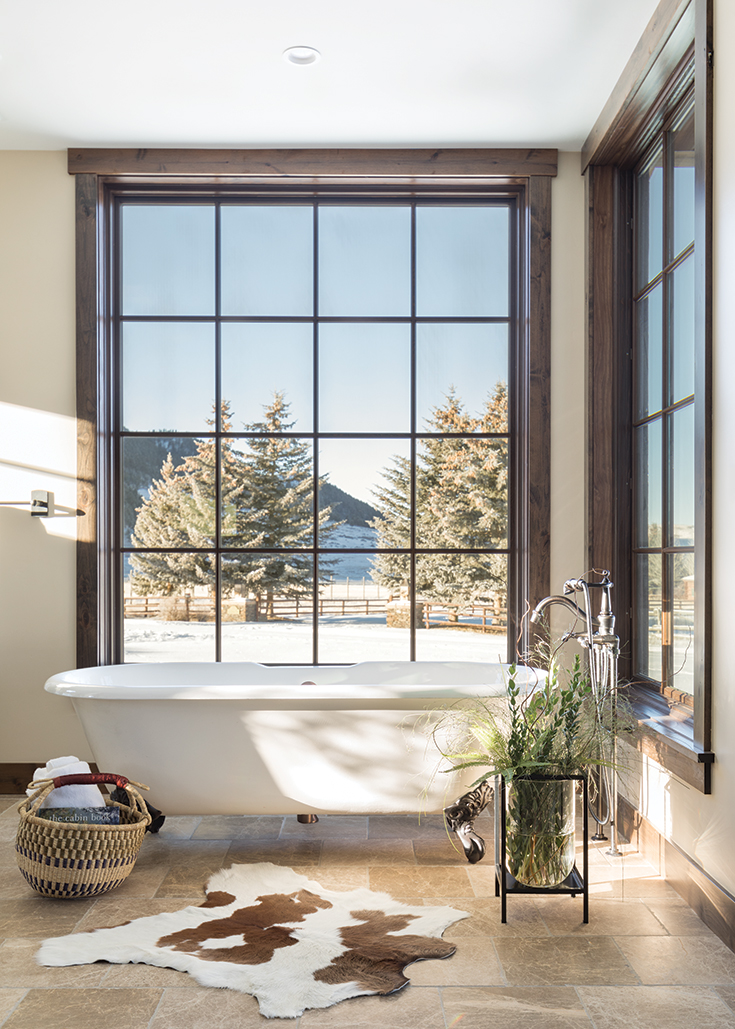
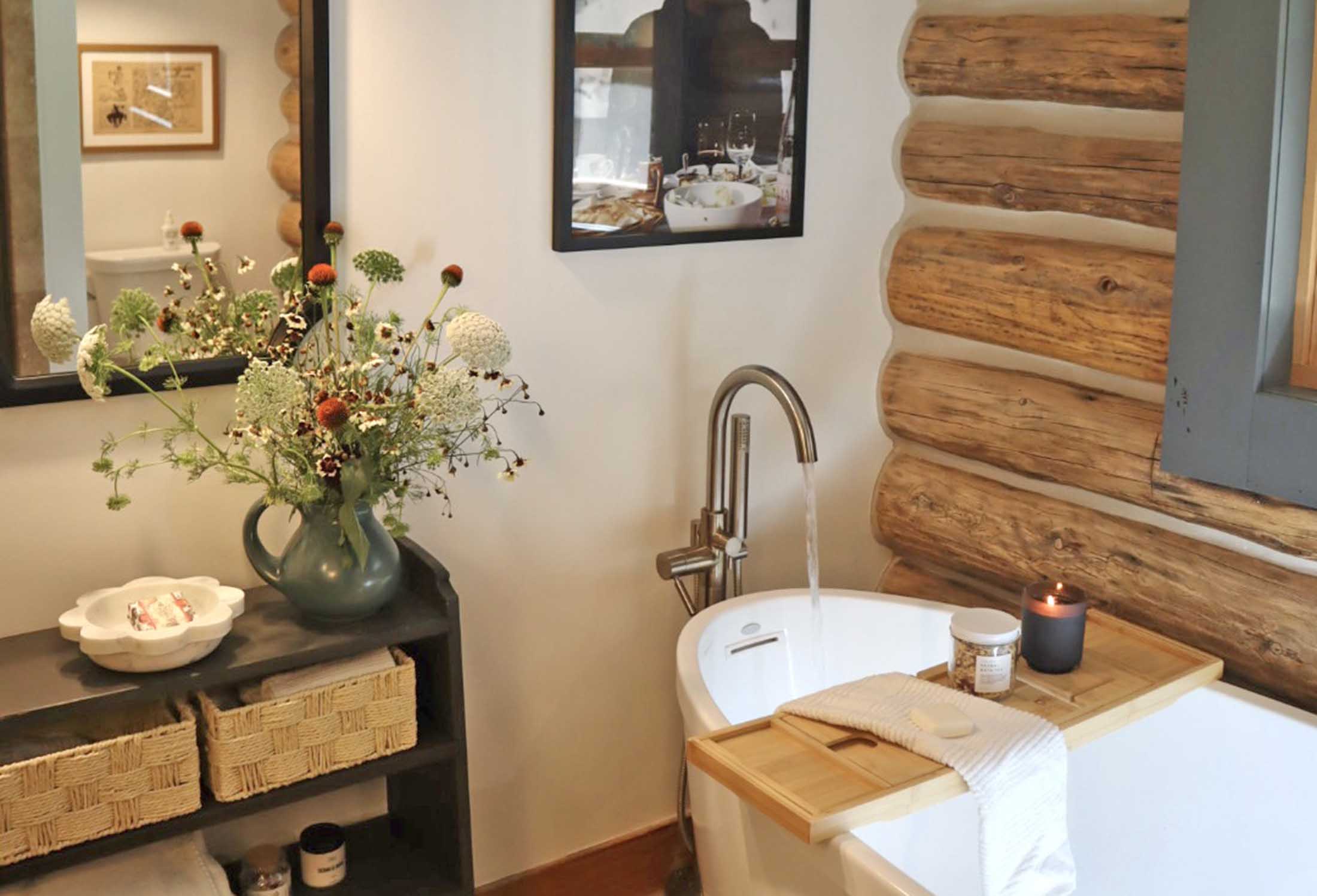
One of the two wings connected to the living room and kitchen holds three bedrooms and a study. The master bedroom, office and a stunning master bathroom are located in the other wing. This bathroom, like the rest of the house, is conservative, in that it is more traditional without a lot of ornate details, but light. The showstopper is the bathtub. The property’s privacy affords it a location in front of a large window that almost gives the sense that the tub itself is outside.

The house is surrounded by stunning views. “We went with some really big windows in all the places that counted,” says Lee.

The homeowner wanted a house with authentic Western comfort and nooks and porches. Lee designed the 5,000-square-foot home in a series of 1,200-square-foot blocks to create a cozy feel. It appears as though one piece was added, and then another, and another, spreading the house out to give a sense of even more space.

“It has a nice charm to it,” Lee says. “It’s like a little compound of cabins.”

The exterior reflects this design, fitting the rambling aesthetic of other homes on the refuge. “We used different roof pitches to make it look like it happened organically,” Lee explains.

The matching reclaimed barnwood inside and outside the house is raw and authentic—Lee even found a bullet hole in one piece. “It all aged together,” he adds. “It looks like it’s been there 100 years. The whole place feels true pioneer rustic, like when you just built with whatever you could get your hands on.”

“We try to under-design in a good way, so it feels a little more natural.”
-Chris Lee

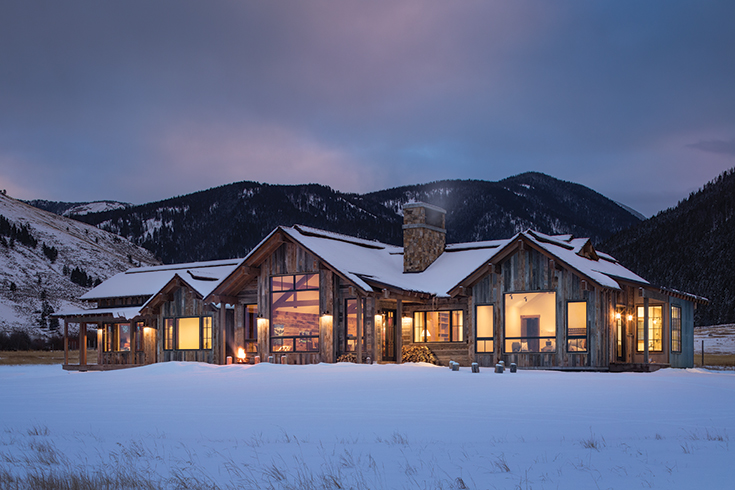
Lee designed this home on the National Elk Refuge as a rustic cabin with a contemporary spin. The house is built with reclaimed barnwood, but he added large, bright windows and clean lines to create an authentic Western home with a modern feel.

The goal was to create a utilitarian, Western feel. Lee also used reclaimed wood for outdoor decks. Private and surrounded with open space, this is a home where people will spend time relaxing beside the outdoor fire pit or watching wildlife from the porch.

“The outside of the house is as cozy as the interior,” Lee says. “It’s not a flashy space; it’s a comfortable, sitting-in-a-rocking-chair kind of space.”

One of the outdoor decks is a small nook just off the master bathroom. This is the owner’s private lounge. “It’s her solace and peaceful place where she gets to take it all in,” Lee says. In this unique spot on the National Elk Refuge, that includes mountains, wildlife and vast open space.

Slopeside Splendor


Architecture
Dubbe Moulder Architects
dubbe-moulder.com

Construction
Dembergh Construction
demberghjh.com

Story By
Michelle Delong
Photos By
Mark Estabrook

The iconic Teton Range rises magnificently, abruptly from the valley floor, both framing the surrounding landscape and defining it. Similarly, a large estate in the mountains has the opportunity to both influence and absorb its natural surroundings, and the most inspiring examples find balance between the two. One such example, the 14,000-square-foot Granite Ridge Lodge, is a luxury home and high-end rental property that seems to rest neatly on the land, despite its grandiosity.

The expansive lodge takes up residence in an upper Teton Village lot that is just under 1 acre. The hillside home captures cohesiveness with landscape and promotes family life unfolding both within and beyond the confines of its walls. Kurt Dubbe, of Dubbe Moulder Architects, explains, “The owners were committed to integrating the indoor and outdoors.”

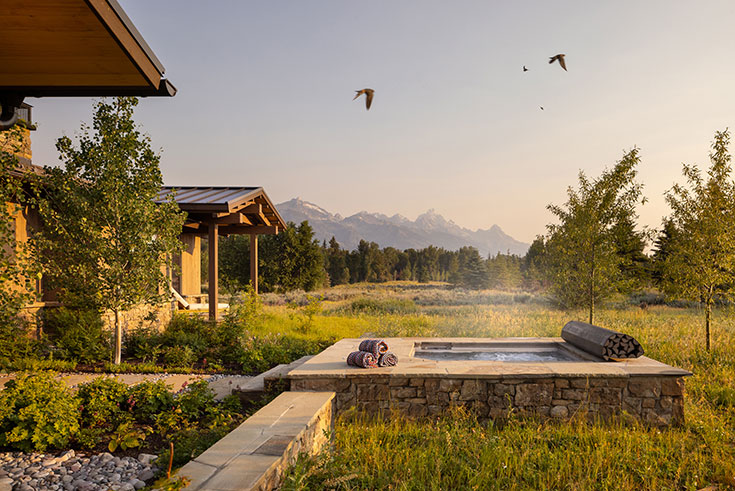
After all, it would be a shame not to take full advantage of such deep and literal connection to the mountains, National Forest land and skier access in Teton Village. The property features not one, but two ski-in/ski-out points to accommodate a larger family and guests. The first point lies on the first-floor level, allowing access from the ski hill through an outdoor living area and covered porch, which opens into a generous mudroom and master wing. The second ski-in/ski-out point exists on the top floor—a unique addition made possible by the lot’s sloped topography—allowing access directly from the ski slope onto a gorgeous outdoor living space complete with a fireplace, barbecue and ample seating for unwinding and enjoying après-ski libations. In the summer, ski access transforms to out-the-door hiking trails and countless ways to enjoy the surrounding protected, public lands.

Ample space to enjoy the outdoors is a consistent feature of this home. Two ski-in/ski-out areas provide family and friends with a perfect home base for adventures.

A project of this size requires a strong vision from the architects and owners, coupled with a contractor who can be both innovative and efficient. As the architects at Dubbe Moulder began to interview prospective contractors, Dembergh Construction quickly rose to the top. Principal Don Frank and his very capable team were able to manage factors like extreme slope and the lot’s location at the top of a hill smoothly by securing a lay-down site at the bottom of Granite Ridge. This enabled the builders to preassemble wall panels before bringing them up to the site, expediting the construction process considerably.

Custom furniture made from unique, diverse pieces of wood are as eye-catching as pieces of art.

Dubbe explains, “All three parties on the project [owner, architect and contractor] had a great line of communication and a very respectful relationship throughout the life of the project.

Granite Ridge Lodge is one of those projects that, in order for it to succeed, it really does require everybody to be in sync with one another, working together. We needed to put the clients in the position to make timely, well-reasoned, thoughtful decisions without creating any delays during construction.”

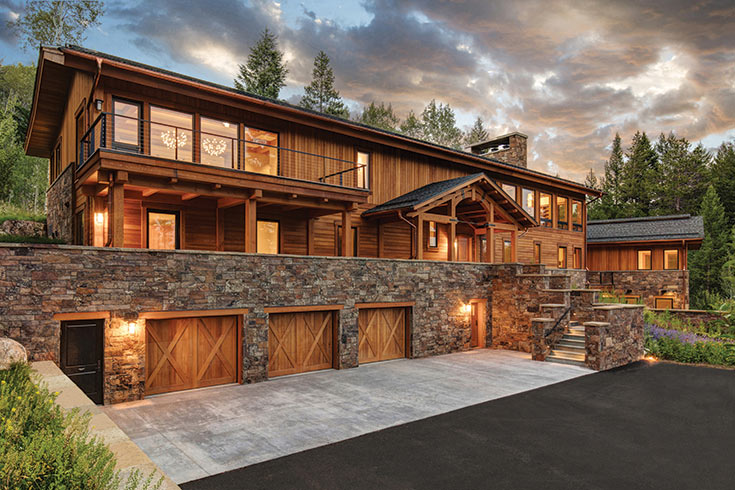
Intricate stonework ties both the indoor and outdoor spaces of the home together and contrasts beautifully with other natural materials meant to reflect the mountainside surroundings.

The home went through many design evolutions and was finished with features that mattered most to the owners, including an outdoor spa, soundproof movie theater and game room. Perhaps the most intriguing part of the interior, however, lies in its use of diverse and beautiful wood. Dembergh Construction created several custom wood pieces, including a bar top in the game room made from a curved slab of American black walnut and a dining room table made from a slab of African mahogany with a live edge. Both pieces look more like works of art than furniture. The owners were committed to integrating these diverse wood species and were intimately involved in their procurement process.

Intricate stonework ties both the indoor and outdoor spaces of the home together and contrasts beautifully with other natural materials meant to reflect the mountainside surroundings.

The lives and personalities of the homeowners are indeed captured by this dream lodge from its foundations to its rooftop, including perhaps the most innovative technology the house possesses: solar panels. As solar company founders and executives, it was important to the homeowners to incorporate these panels, which supplement the home’s energy consumption. This commitment to sustainability is a beautiful ode to Granite Ridge Lodge’s astounding alpine environment, and a lasting reminder of the majesty of nature.

From There to Here

The Sourcing Artistry of WRJ Design

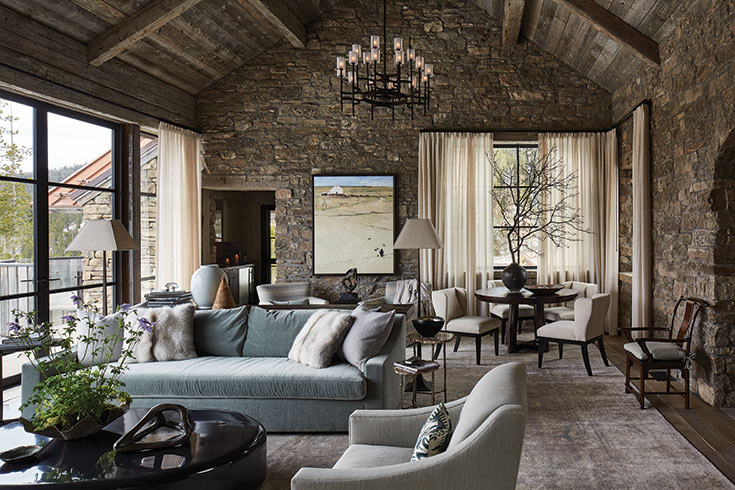
Harmony and livability with plenty of light. In the living room, WRJ created this custom silk-and-woolen rug by Mansour to bring all the tones and textures together.

Interior Design
WRJ DESIGN
wrjdesign.com

Story By
ZACHARY Barnett
Photos By
William Abranowicz

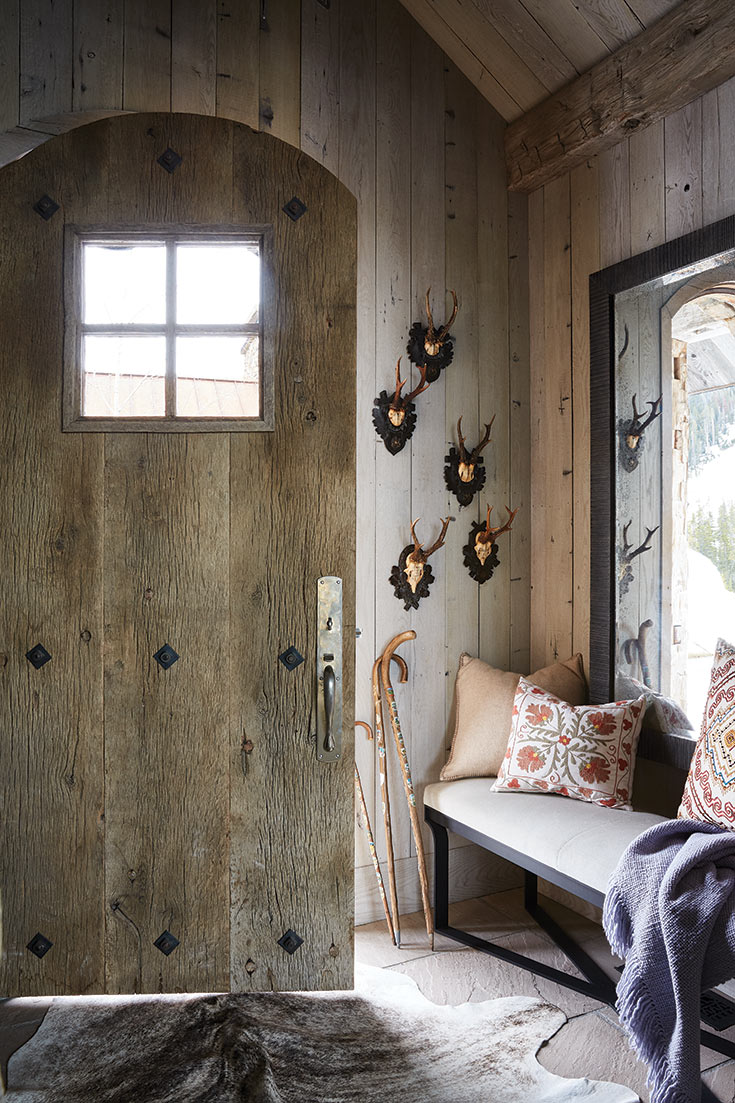
In the entranceway of a spectacular 8,500-square-foot home, at an altitude of nearly 10,000 feet and within the gates of the Yellowstone Club in Montana, 19th-century German roe deer antler mounts hang on the wall. On each is inscribed the year as well as the location of the hunt. On the floor beneath these mounts stands a collection of German and Austrian bentwood, metal-tipped hiking canes adorned with painted metal badges, called stocknagels, which were once a way of commemorating local hikes with something unique to a town’s heritage. On some of these canes are inscribed the names of their owners.

How the story begins: with stocknagels on bentwood hiking canes and trophy roe deer mounts.

In storytelling, the tale begins when the main character walks out the front door. However, it is the philosophy of Rush Jenkins, CEO of WRJ Design, in Jackson Hole, that the story must always begin when you walk in the door.

“For us, design has never been about just fabrics and furniture,” explains Jenkins. “A chair is a chair. Real design is about sourcing the many layers of history, culture, craftsmanship and nature. We’re far more interested in bringing depth and context to the project—and creating real emotion—because that’s who we are, and we seek out a clientele who will appreciate this.”

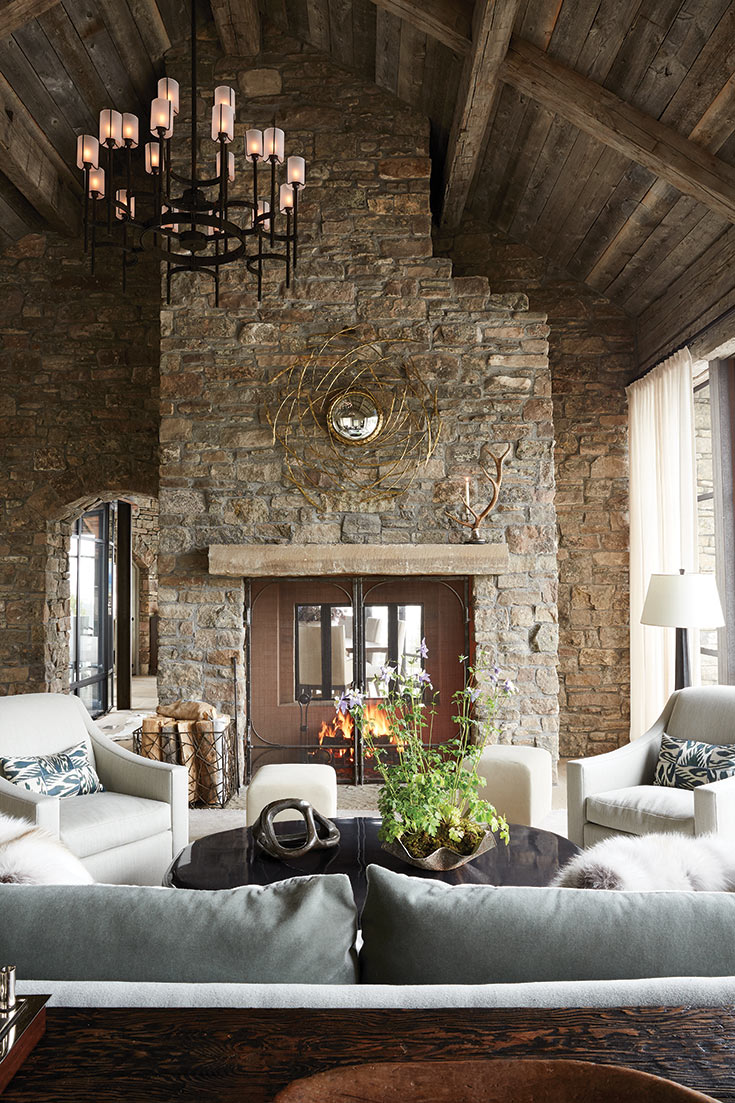
The faux bois firewood bin and Van der Straeten handwrought bronze tumbleweed mirror are fine examples of Rush Jenkins’ “natural elegance,” the title of the hardcover book to be released in October 2019.

The layers Jenkins alludes to can be found in his partner’s, Klaus Baer’s, Austrian heritage and experience managing international investment production teams, and in their Director of Design Nida Zgjani’s upbringing in Albania, where she studied architecture at the University of Engineering. It is also evident in Jenkins’ own rich history working with Sotheby’s in London and New York.

Additionally, Jenkins continues to thrill as the creator of exhibits; most recently, he received accolades for his show at the St. Petersburg Museum of Fine Arts featuring the one-of-a-kind jewelry of Jean Schlumberger.

“We are more than designers,” adds Baer. “We are curators, collectors and stewards, passing on our passion to our clients. WRJ is about the discovery of wonderful things. This discovery happens for us in Paris and in the auction houses of New York. It happens on Portobello Road and in the streets of London and in the bazaars of Turkey. We’re looking to tell a story, to create real magic, because when that happens, suddenly the whole becomes greater than the sum of the parts.”

In this particular home, a collaboration with the clients and JLF Architects, the stories are everywhere.

“I’d be in a meeting,” recounts the owner about the early design stages of her home, “and I’d get this text from Rush in Paris, saying, ‘You have to see this!’ I’d excuse myself to look at a photograph of a set of tables or a lamp with this blue-green labradorite stone mounted on it. I came to trust him because he always seemed to know. And it was so much fun.”

The motto of WRJ Design is: “Inspired by the natural world. Informed by the rest of it,” which is why they’ve always worked so well with JLF, architectural visionaries who’ve also established a reputation for seeking new ways to bring the outside in and nestle their structures within their surroundings.

“The beauty of working with Rush and Klaus,” explains JLF design principal Paul Bertelli, “is that when we start the planning process with them, they get it. The goal posts are clearly defined and we’re all working toward that same uniqueness. They get that our buildings are integrated. They’re one piece. The inside informs the outside and vice versa. A stone wall outside may very well run through the entire house, so those textures and finishes have to be considered. They anticipate this, and it’s magic when it happens.”

The natural world is very much alive in this home, from the living room’s faux bois firewood bin and Van der Straeten handwrought bronze tumbleweed mirror over the fireplace to the porcupine-quill box from Ceylon in the hallway outside the master suite.

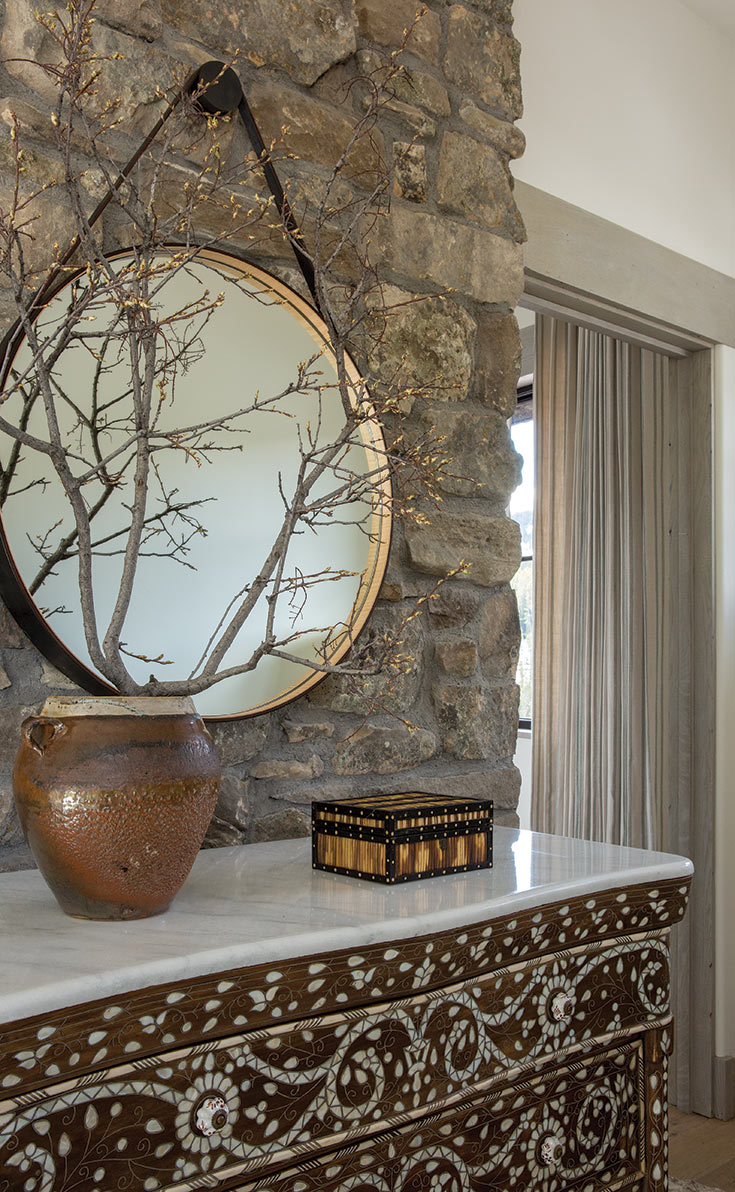
Artifacts of beauty and wonder. In the hallway outside the master bedroom stands this finely crafted Syrian chest of drawers inlaid with mother-of-pearl. On top is the porcupine-quill box from Ceylon, circa the late 1800s.

“From the beginning,” explains Zgjani, “we were after an almost zen-like harmony with plenty of light. Take the living room, for instance. We created a floor plan for how the family would interact with the space, whether during a cocktail party or an intimate family game of cards. The owners wanted a real livability, a flexibility, which would allow them to rearrange the pieces. And once we had that, we worked on our textures and tones. The Loro Piana fabrics, the Holly Hunt black-lacquered tables, which threw light everywhere, the blue-green mohair upholstery with its rich, cozy sheen, and the petrified-wooden end tables Rush found in Paris. Then we brought it all together with the custom silk-and-woolen rug from Mansour, with all those soft, neutral textures and tones found in the fabrics and stonework.”

But even within these boundaries, there was room for both whimsy and surprise. Downstairs in the hallway, for instance, there is a collection of mock historical photographs of Indians downing a fighter plane with bows and arrows. And in one of the daughters’ bedrooms, there are wonderful pink beads sewn into the white linen of the canopy.

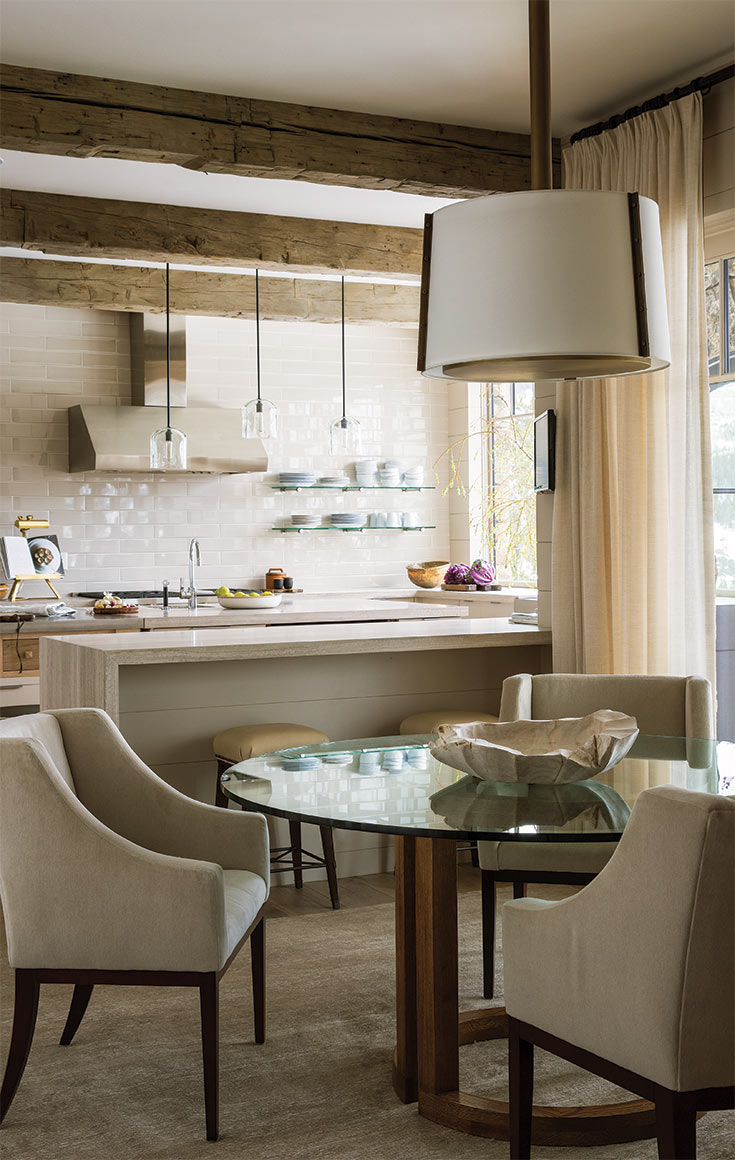
When the architect brings you light … The homeowner’s wishes were contrary to the traditional dark mountain cabin. WRJ used these creamy shiplap kitchen tiles and Holly Hunt light pendants to brighten the space.

And then there is the Syrian chest of drawers. It stands at the top of the stairs in the hallway outside the master bedroom in finely crafted dark walnut, intricately inlaid with mother-of-pearl. Topped with white Mediterranean marble, it was created sometime between 1900 and 1960 on the plains of Hauran, between Damascus and Jordan. Originally, pieces like these were crafted as bridal gifts, but they soon found a more lucrative market in the West. The mystery of how these craftsmen came by their skills in a country where only 2 percent of their land is forested is difficult to solve. With Syria at war, the artisans have either fled to Lebanon or been lost in the strife.

“Rush, Klaus and Nida knew,” says the homeowner. “From the very beginning they drilled down to an understanding of what would make our house special. And then they went out and found all these eclectic furnishings and made them work together, rich with history and story, and never contrived. We wanted a home that would feel like we’d lived there forever, and that’s what they delivered.”

Architectural Connections

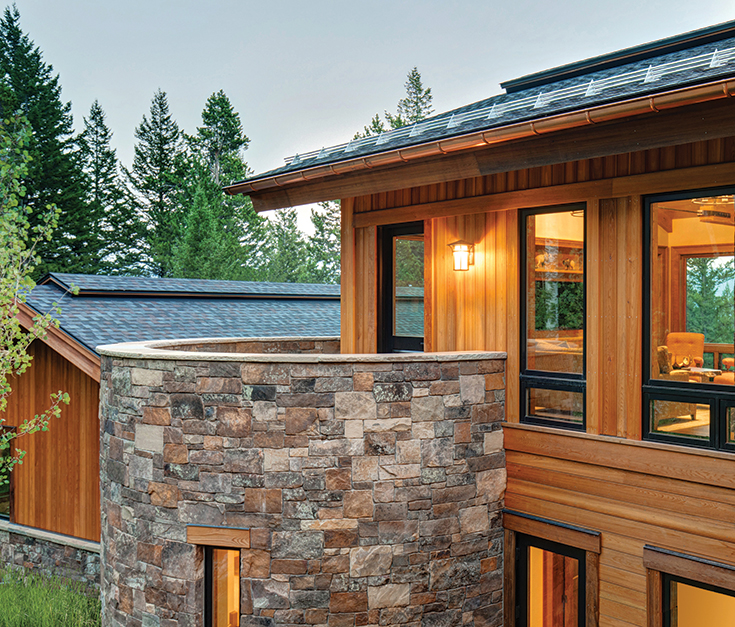
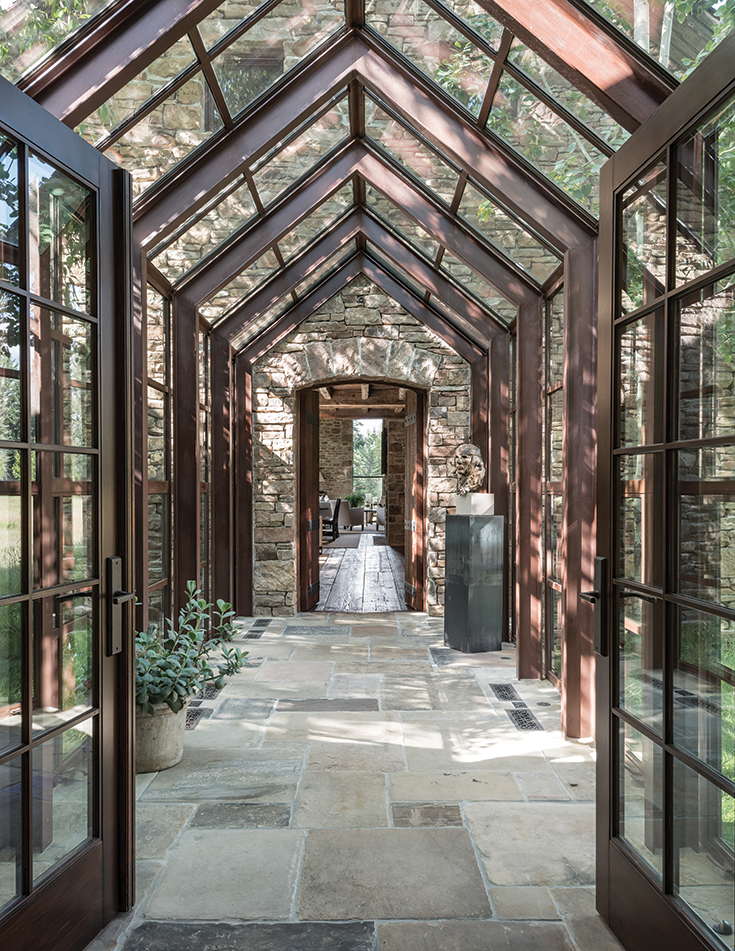
Contemporary components of steel and glass were used in this passage to connect the reclaimed stone building to newer construction in the rest of the house.

Architecture
JLF Architects
jlfarchitects.com

Construction
Big-D Signature
big-d.com

Landscape Design
Verdone Landscape Architects
verdonelandarch.com

Story By
Seabring Davis
Photos By
Audrey Hall

For four decades JLF Architects has been creating connections through architecture. Connections to place and history, to people and the landscape. The impact of timeless design is what makes The Creamery, a house on the Snake River Ranch, so distinct.
“Our philosophy is making contemporary spaces with reclaimed materials—the parts and pieces of old buildings,” says partner and design principal Paul Bertelli.

Since the firm was founded in 1979, Bertelli and his partners have been known to occasionally drive around the country searching for old, neglected—and beautiful—architecture, such as dilapidated barns and cabins, stone structures, even old fencing. JLF pioneered the use of those recycled components in their designs.

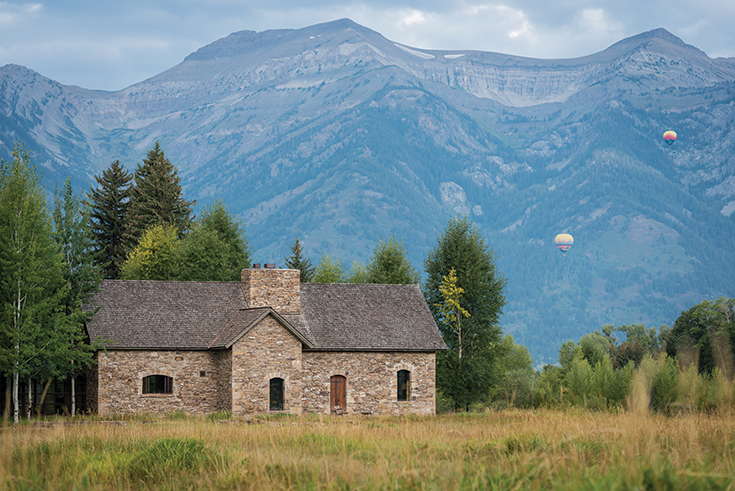
This home incorporates stone from a forgotten 1890s dairy barn in Montana. The stone creamery was dismantled, moved piece by piece, and reconstructed in Wyoming. Built on a property that was once part of a large homestead ranch, the architectural language of the house honors that pastoral link. Combining rustic stone and reclaimed wood with refined style, the owners found a way to re-imagine a home on the range.

Utilizing the ruins of an early 1890s limestone creamery, JLF Architects reconstructed the structure stone by stone as a new home near Jackson.

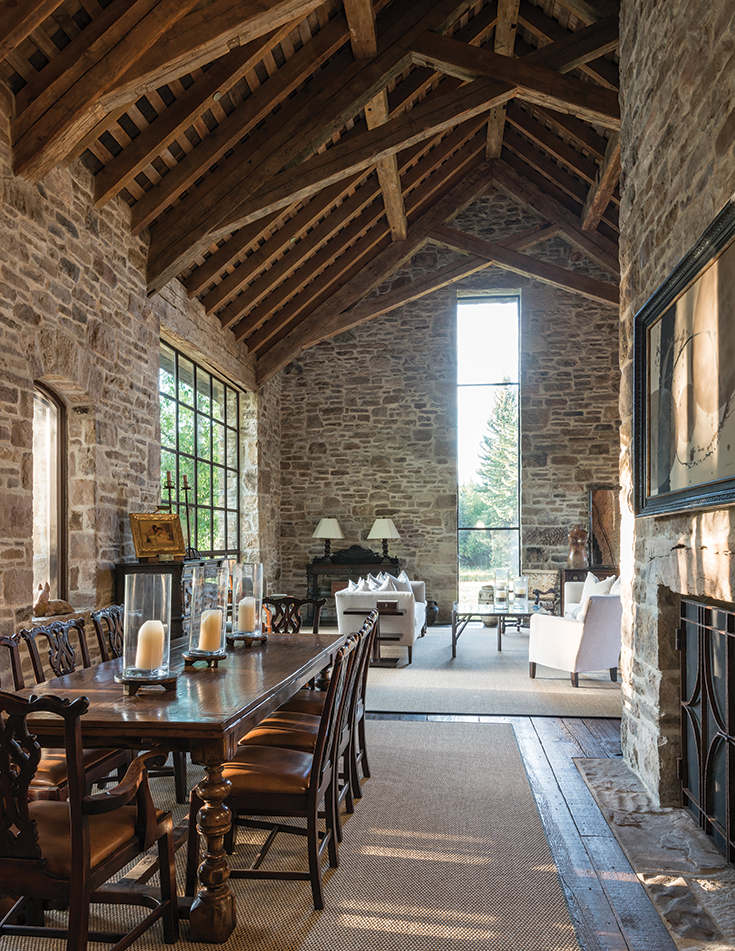
The reclaimed stone was incorporated in the living, dining and kitchen spaces, all reassembled in original form. Adding personal touches, the owners folded rustic furnishings with comfortable current pieces into the interior design throughout the home. Antiques pepper the living spaces, including a French refectory table and Chippendale chairs to anchor the dining room.

The home represents the owners’ personal connection to the land, as well as an example of what has become a JLF Architects signature: the melding of old and new elements into contemporary architecture. Partner Logan Leachman credits JLF’s philosophy of working hand in hand with construction company Big-D Signature, trusted artisans and craftspeople.

Inside, a French refectory table and Chippendale chairs add a touch of refinement to the rustic materials of the home.

“A design-build approach has allowed our team to look at the design of each structure holistically to create continuity and quality within architecture,” explains Leachman.

The Creamery is evidence that dedication to building timeless structures rooted in integrity and elegance shows best when natural materials, inspired design and an ethos that stems from a unity of nature, beauty, balance and imagination all come together.

More Than Mountain Modern

The beautifully crafted Montana moss rock fireplace adds an organic element to the great room.

Stockton + Shirk Interior Design
Stocktonandshirk.com

Story By
Julie Fustanio Kling
Photos By
Samantha Livingston
Designer
Lisa Hatcher

Stockton & Shirk Interior Design’s senior designer, Lisa Hatcher, connected with a European-based couple who wanted to deepen their roots in Jackson. She was able to begin from the ground up, working directly with the architect and contractors to help build a new three-bedroom, three-and-a-half-bath, 4,000-square-foot home in Jackson.

“The inspiration of the home was to incorporate natural elements to soften modern lines.” -LISA HATCHER
“The clients wanted a comfortable mountain home with modern design elements to share with family,” Hatcher says. “And they were open to adding some vibrant colors to an earthy palette.”

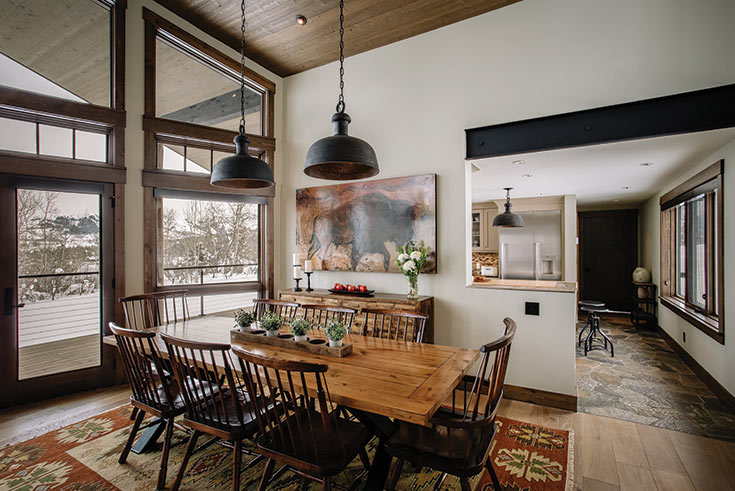
Large, rustic pendants hang in the kitchen and dining room, bringing your eye effortlessly from one room to another.

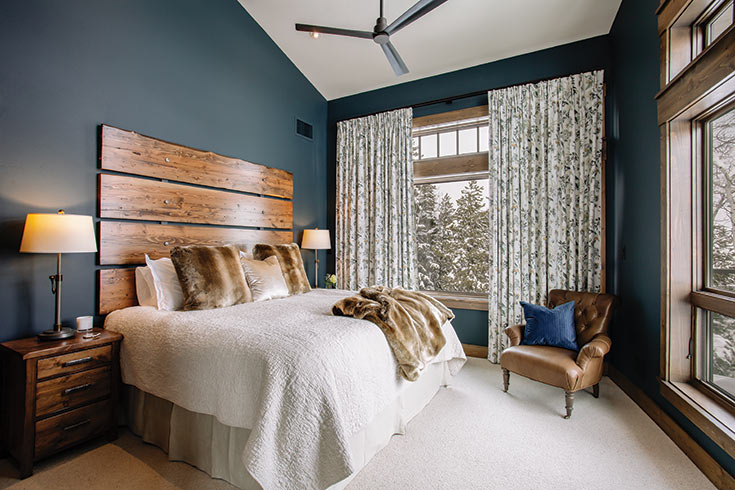
In the master bedroom, Hatcher suggested Benjamin Moore’s Narragansett green for the walls to accompany the bold floral print on the draperies. A local woodworker crafted a reclaimed-oak headboard and matching nightstands to bring a rustic aspect to the room.

The dining table was created locally using a distressed-plank table top and steel base. Hatcher paired the table with an updated Windsor chair from a UK manufacturer. Large, rustic pendants hang in the dining room and kitchen to offset the contemporary, black I-beams.

Bold paint accents a classic floral print drapery. The master’s grandness and vaulted ceilings echo the mountain views.

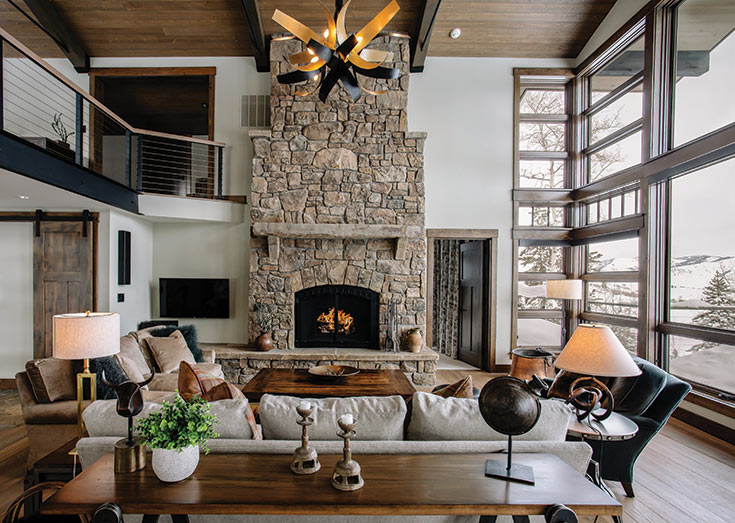
A Montana moss rock fireplace with a stone slab mantel is the centerpiece of the family room. The unique chandelier, hanging from the tongue-in-groove vaulted ceiling, brings a modern twist and a bold presence to the room. Floor-to-ceiling windows tie the great room and dining room together seamlessly to the expansive outdoor living space.

“The steel chandelier has a soft gold interior finish that casts a warm glow in the room and on the stone fireplace,” Hatcher says. It harmonizes with the other modern elements, including exposed I-beams and a floating steel-and-wood staircase.

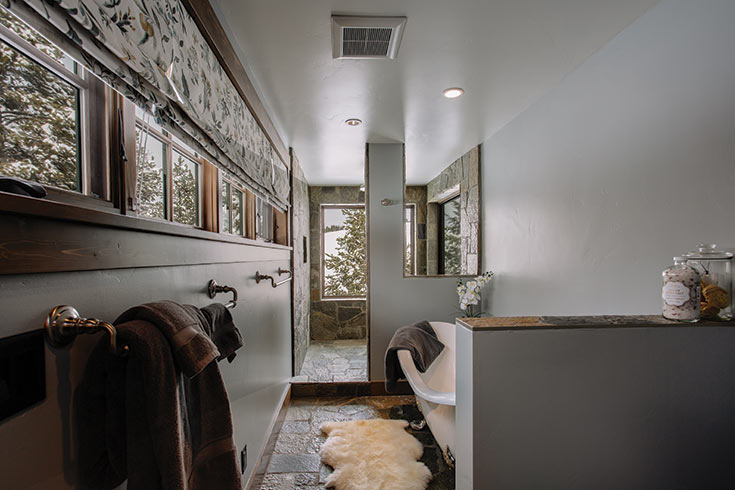
Contemporary, clean lines contrasted with soft textures create an inviting master bathroom.

One of the most innovative details of the new home’s design is in the master bathroom shower. Large, corner-framed windows and Oakley stone bring the outside in, thus realizing the clients’ vision of having an “outdoor” shower in a winter environment. This stone is represented throughout the kitchen and master bathroom to create a cohesive flow.

“The inspiration of the home was to incorporate natural elements to soften modern lines and materials. We wanted to create a comfortable, updated, Western mountain home,” Hatcher says.

Stockton & Shirk Interior Design occupies 3,500 square feet of storefront at 745 West Broadway. The signature red building with striped awnings and cheerful window boxes features a design studio and furniture showroom. The European exterior charm is a curiosity to many. Designers, whether they are local or from out of town, will find a reliable place to source fabric, furniture, lighting, art and accessories. The portfolio of Stockton & Shirk’s team of designers is as diverse as their client base. They love the challenge of bringing a client’s vision and personality to life through the design of a home.

“The strength of our office is in the fact that we don’t work in a specific genre,” says owner and principal designer Melinda Shirk Dorion, who purchased the 30-year-old firm from Pamela Stockton in 2010. “Our business is client-driven. We work in a variety of styles that speak to the client, and the design is facilitated by our team. The majority of our clients are not local to Jackson. It is not uncommon for us to work with our London, Singapore, Hong Kong and Moscow clients remotely. Whether it’s working across the world or state lines, our motto is ‘The Design Firm Next Door.’”

The Stockton & Shirk showroom at 745 West Broadway is a mix of mountain modern and classic styles, featuring fabrics, local artisan furniture and one-of-a-kind accessories.

Pamela Gibson AD Infinitum

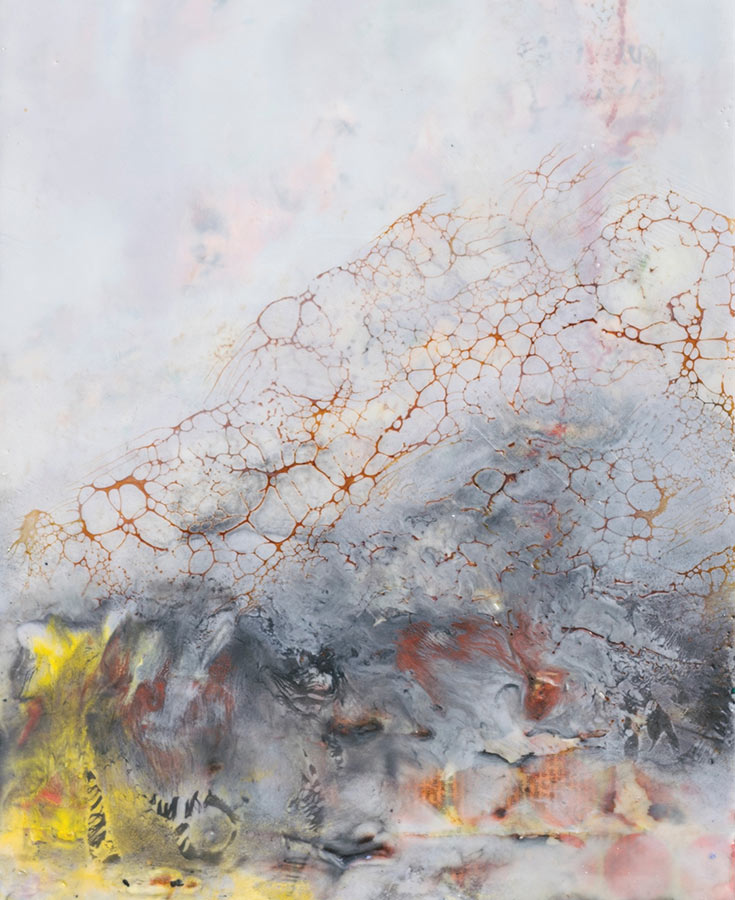
Where There’s Smoke There’s Fire, encaustic on panel, newspaper, shellac, graphite, 12 x 24 inches

Pamela Gibson Art
pamelagibsonartist.com

Story By
Katy Niner
Photos By
David Swift + David Gonzales

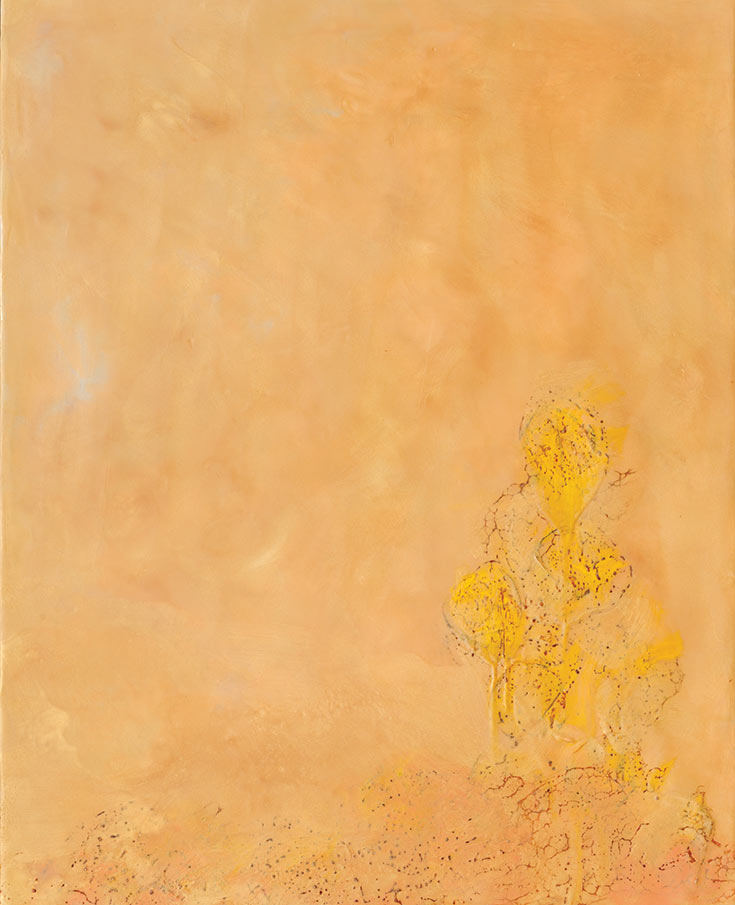
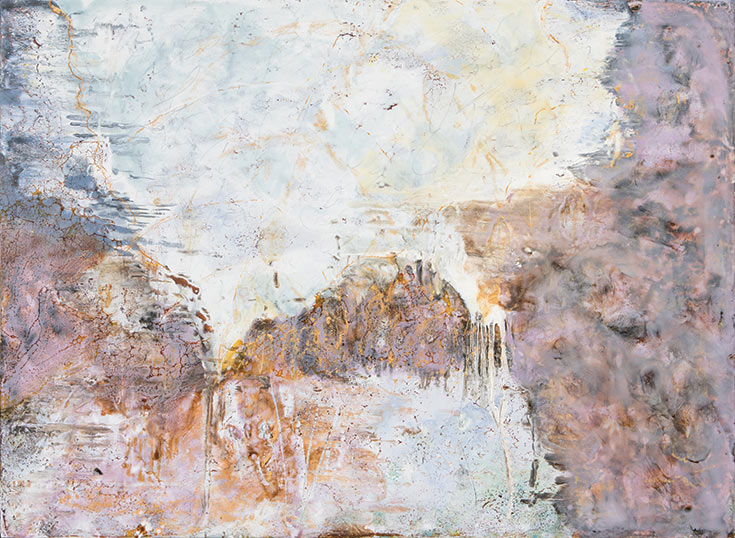
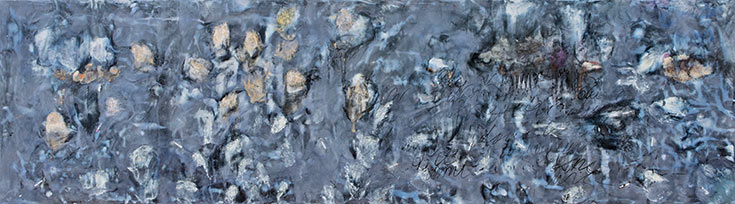
Pamela Gibson’s wide-angle lens on natural life translates into a body of work at once intimate and resonant. By her hand, the cadence of time translates into layered marks as intricate as the phenomenon she acutely observes outside: the ephemeral encounters, the changing flora, the beautiful decay, the variable pacing of time, time’s imprint on memory and manifestation in organic matter. These are all affects present in her paintings. Working in a spectrum of sizes—from small squares to ambitious boards—she explores the breadth of time through the depth of materiality.

“Let It Be”—Paul McCartney, encaustic on panel,
shellac, burned dress patterns, 24 x 30 inches

For Gibson, art exists at the alchemic crossroads of place and time, intellect and emotion. Ever exploring the rugged world that surrounds her, she processes her experiences in place through her art. In her studio, she absorbs and interprets. She collects cues from music, poetry and photos. From her studio window, she ruminates as she monitors the ever-changing scene outside. She follows the light. She observes and orders shapes as they change. She responds, whole-heartedly, to living amid wild nature in conceptual context.

“In Every Leaf Is the Pattern of an Older Tree”—Sting, encaustic on panel,
angels dancing on pins, graphite, synthetic leaves, shellac, 60 x 48 inches

Encaustic painting has become her filter, informed by all the creative forms she finds inspiring: literature, media, adventure, as well as her previous work in fibers. Amid the whirling world, she pulls out moments of profundity—ideas that make sense of the current chaos. Ideas that continue to accumulate and communicate, in ever-surfacing affect, on the walls of collectors’ homes.

“The Answer is Blowin’ In the Wind”—Bob Dylan, encaustic on panel, carbon, charcoal, dress patterns, oil, graphite, shredded memories, 84 x 24 inches

Finding pause in the temporal flood, Gibson builds her paintings as narratives. She never starts with the easy plot, the iconic vista, instead focusing on the essence of the landscape, its lessons—how a patch of willows scores a field, how a boulder disrupts an evergreen stand. Landscape as point of departure. Countless paintings live beneath the surface of each finished work, traces of her expectations subsumed so that the composition can become itself. Hers is a process of liberation—of painting and painter. Worked and hard-won yet resolutely serene, her abstractions stay with viewers long after the initial encounter, inviting layered readings. Meaning rises from their complexity and poetics, viewers’ memories and associations. A conversation started by her hand, then continued by collectors—a limitless dialogue between aesthetics and experience, material and humanity.  

Coalescing Architecture


Story By
Katy Niner
Photos By
Vera Iconica Architecture + Longhi Architects
When space, emotion and environment coalesce, architecture becomes art, and the affect is limitless—as felt by the people who experience such inspired spaces. This concept was truly vanguard when Mexican architect Luis Barragán so astutely articulated it decades ago—and remains so today.

“Architecture is an art when one consciously or unconsciously creates aesthetic emotion in the atmosphere and when this environment produces well-being.” -Luis Barragán

Art as architecture as wellness: This is the core dynamic driving the new partnership between aesthetic visionaries Jackson, Wyoming-based Veronica Schreibeis Smith and Lima, Peru-based Luis Longhi, who have joined continental forces; Longhi is the inaugural guest resident at Vera Iconica Architecture. Together, the two talents are trailblazing an international movement toward mindful design: mindful of people, of nature, of cultural heritage and of material integrity. Intuition anchors their design process—the insight based on instinct, experience and creativity. When layered with the practical and the rational, says Schreibeis Smith, the result is “functional, smart spaces that have soul.”

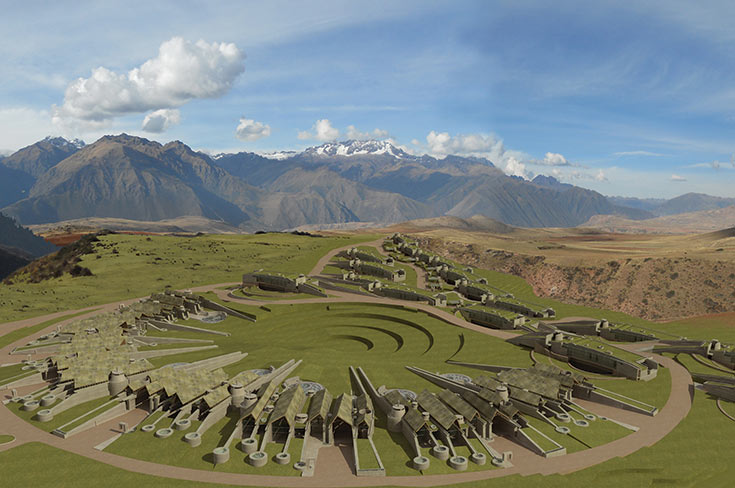
Case in point, the architects’ inaugural collaboration: Pachacamac, a ridgeline refuge built for a Peruvian philosopher. True to the philosopher’s intellect, the residence grows from his library, starting with a central courtyard carved into the hillside, open to the sky. On either side, the library’s wings stretch east and west, spanning the sun’s daily arc, in deference to Peru’s vibrant mythology, symbolic of earthen knowledge extending out to eternity. The house unfolds from this intimate library into more social spaces. “As the program of the house involves more people, it becomes light and more open, culminating in a glass-cube living room to gather guests,” says Longhi.

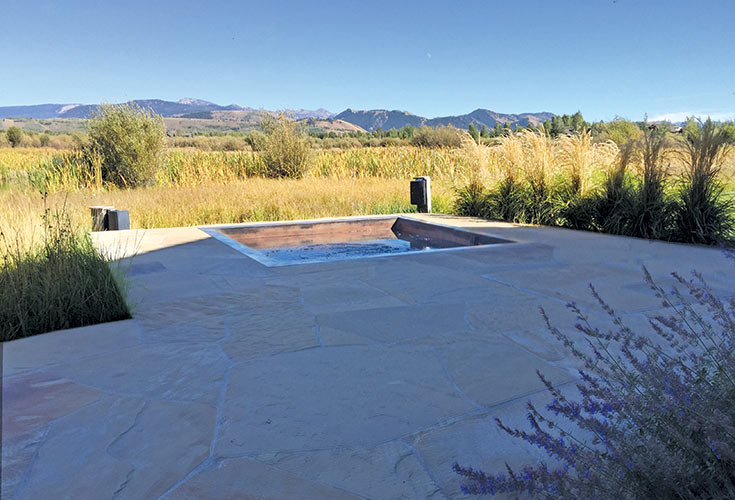
At Vera Iconica, listening is paramount to the proprietary Intuitive Design Process. The firm considers how architecture impacts people, purpose and planet, using materiality and one-of-a-kind elements to affect clients’ sense of their world and their place within it. Such an approach manifests in masterful details, whether the precise siting of an outdoor hot tub or custom mapping of kitchen cabinetry. “Not only do we listen deeply to our clients, we also read their body language, and ask thought- and emotion-provoking questions,” says Veronica Schreibeis Smith.

“We believe that every person should live in a masterpiece,” the architects say in their vision statement. “And beyond that, we believe that every person deserves to have a home that is not only beautiful, but one that enhances their well-being and quality of life on a daily basis. We define a masterpiece as something that moves our clients, inspires them and elevates them—a work of art, a piece of music, a shared conversation. Essentially, we design experiences. Architecture just happens to be our medium.”

Their work is closely tied to the landscape and epitomizes the aesthetic shared by the two internationally recognized architects, as seen in the conceptual design by Longhi Architects for the premier destination resort Valle Sagrado

Schreibeis Smith and Longhi draw daily inspiration from the nature that surrounds them—she in the Tetons and he on the Altiplano Plateau. “In these places of soaring beauty, we find not only architectural inspiration, but also inspiration on what it means for a life to be lived well,” Schreibeis Smith explains. “To us, that means homes that are designed for wellness and to communicate with the surrounding landscape, designed with local materials, and always in respect for the environment.”

Vera Iconica wants its clients to feel as elevated as their surroundings, attuned to nature and their true natures. Ultimately, the firm’s goal is “to design spaces where our clients derive joy and experience a life of meaning, in beauty”—a benchmark that circles back once again to Barragán and his profound eloquence: “Beauty is the oracle that speaks to us all.”

Veronica Schreibeis Smith and Luis Longhi started working together in 2006 in Peru and in 2015 began discussing ways to align their synergistic visions as architects.

Conceptual Curating

Work by internationally acclaimed artists Jordan Eagles and Kiki Smith preside in Camille Obering’s living room.


Story By
Meg Daly
Independent curators Matthew Day Jackson, Andy Kincaid and Camille Obering have teamed up to produce multi-genre, site-specific installations and performances that are changing the landscape of contemporary art in Jackson Hole, putting it on the map for cutting-edge art.

Recent exhibitions, such as “Rural Violence” and “Observatories,” challenged audiences with new ways of looking at the West. For instance, an installation in “Observatories,” by the venerable contemporary artist Paul McCarthy, called into question our fascination with gory stagecoach fights and Old West violence.

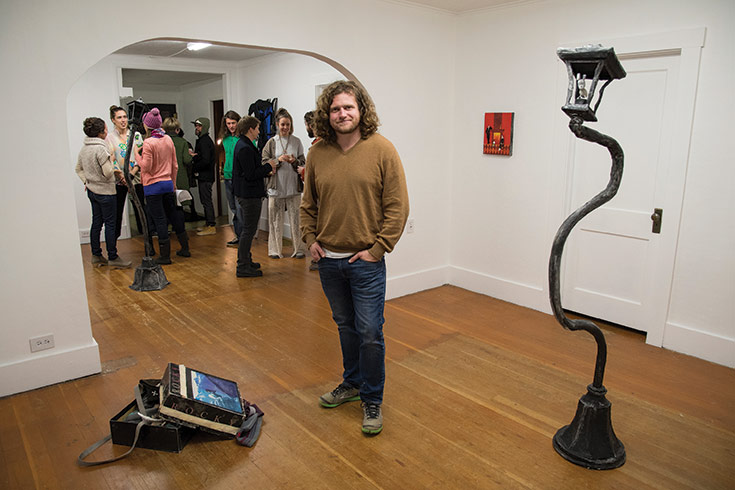
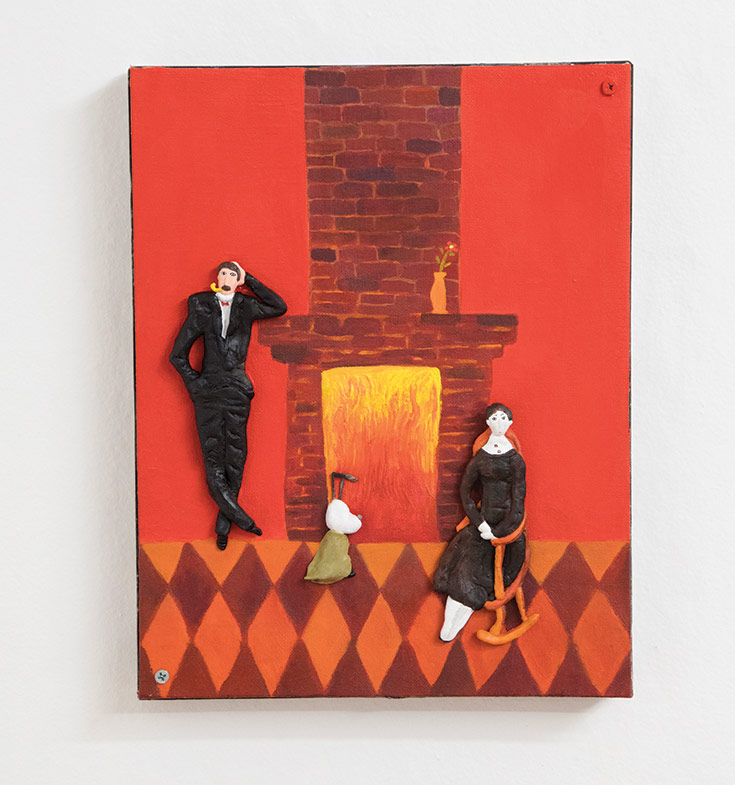
Andy Kincaid transformed his rented home into a contemporary art gallery. Featured here: work by Dennis Witkin. holidayforever.org

With their abiding passion for conceptual art, how do these non-traditionalists approach curating their own art collections? How does Western topography intersect with their personal artistic tastes?

Kincaid, an artist himself, has transformed his home into an art gallery called Holiday Forever. The name is a play on the notion of Jackson Hole as a perpetual playground. Each month, he and his partner, Amanda Flosbach, turn over the front two rooms of their rented Cache Street home to visiting artists to do with as they see fit. Often, Kincaid does not know in advance what his guests will be exhibiting. “I allow the gallery to be a vessel for artists’ concepts,” he says.

Making his home into a rotating door for contemporary thought could be considered an art project in itself. The transience of the art and perpetual transformation of the space mean his home is always infused with new and diverse ideas.

All three curators agree that art can give your life context and broaden the way you experience the world. “Art is a way to talk about history,” Obering says. “It can say something about a particular period in your life, as well as the world at large.”

As a fine art dealer, Obering’s doctrine for her personal art collection mirrors that of her other projects. “The crux of what we’re trying to do is collect ideas and people,” she says of her work with Kincaid and Jackson. Her home in Schofield Patent, which she shares with her husband, Ben Musser, and their two young children, boasts work by notable contemporary artists such as Jordan Eagles, Tara Donovan and Kiki Smith.

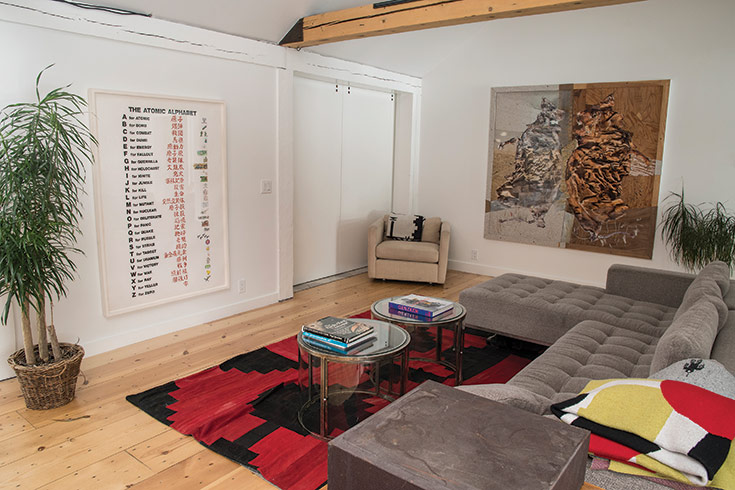
Large works by legendary performance and installation artist Chris Burden (left) and Larry Bamburg (right) at Matthew Day Jackson’s Fall Creek home.
Obering says the artwork in her home converses with nature. “And Western life is always in this conversation,” she says. Large picture windows look north toward the Tetons and invite the outside world inside. A print by Neil Jenney punctuates the living room: “Art is nature adjusted,” it reads.

Like his cohorts, Jackson is drawn to art that asks question and conveys concepts. “An artwork is like a battery that carries ideas,” he says. An internationally respected contemporary artist, he makes his home in Wilson with his wife, Laura Seymour, and their two children. Among other achievements, he has exhibited in the Whitney Biennial, and his work is included in the Metropolitan Museum of Art’s permanent collection.

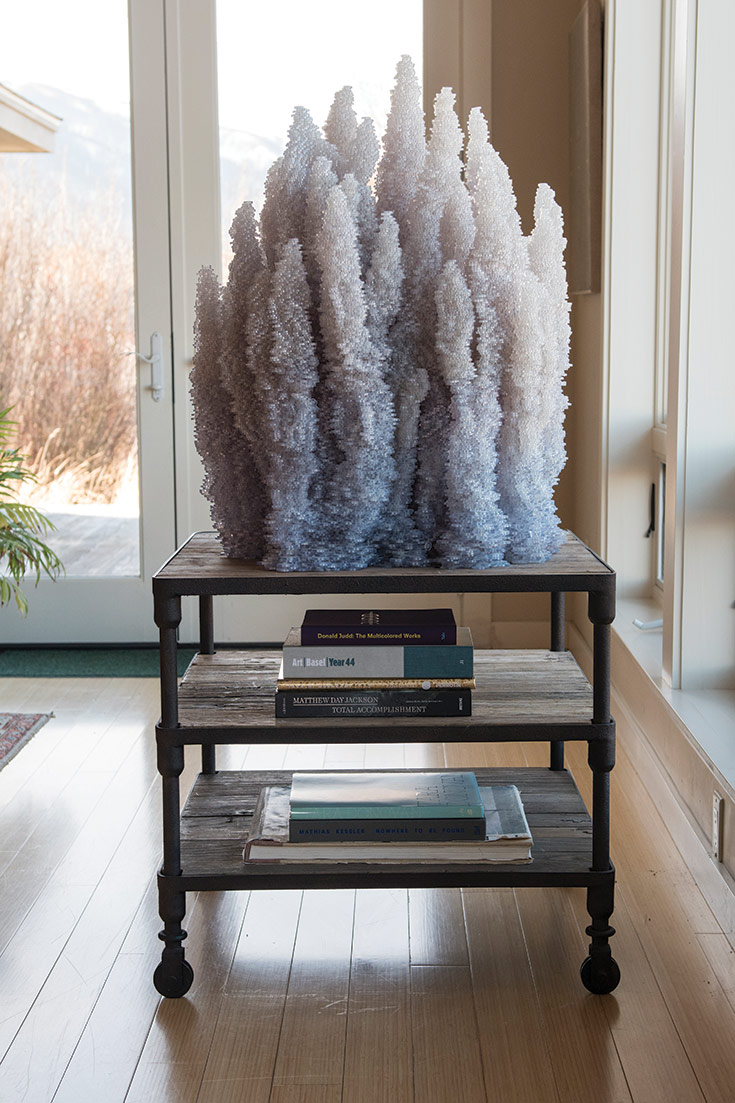
Tara Donovan’s button sculpture at Obering’s home.

Jackson sees his relationship with pieces of art like relationships with people. “When you are drawn to a piece of art, there might be an aspect of yourself represented there.”

All three curators collect work by the artists they bring to town. It may not always be harmonious with traditional mountain-town aesthetics, but that’s not the point, they say. Instead, the team feels strongly that avant-garde views are a vital part of Jackson Hole. “It’s an energy we are trying to prolong here,” Kincaid says.

Designing From The Inside Out

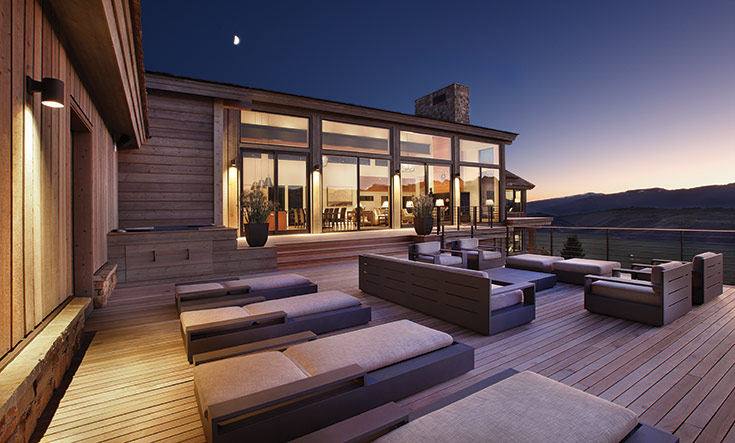
Looking in is like looking out; from the window placements to the paintings that hang on the walls, everything about this house reflects its mountain views.

ARCHITECTURE
Berlin Architects
berlinarchitects.com

Story By
Julie Fustanio Kling

Photos By
Jim Fairchild

If every house speaks a different language, the latest design by Berlin Architects is fluent in the echoes of the Teton Mountain Range. The rustic cedar-and-stone exterior is modest. But once you cross the threshold, rustic turns contemporary. The interior space resounds with natural light and views from enormous windows, establishing a secret vocabulary with nature.

Perched on a butte on the north side of Spring Gulch, the private residence is like a minimalist treehouse, a reflection of the restrictive footprint on the hilly 18-acre lot and the owners’ love of clean lines.

“The lot wasn’t so much of a challenge as it was a collaboration, because the owner has an architectural background,” says Gabriel Vazquez, Berlin’s project manager. The outcome is an architect’s—as well as the owner’s—dream house.

This project was three years in the making. The firm and the owners went back and forth with drawings and site plans that now fill a built-in bookshelf in the home’s office, the room with the most intimate vista of the Grand Teton.

“We created a rhythm with the windows,” Vazquez says. “And we were not shy about exposing all the structural steel holding the house up.”

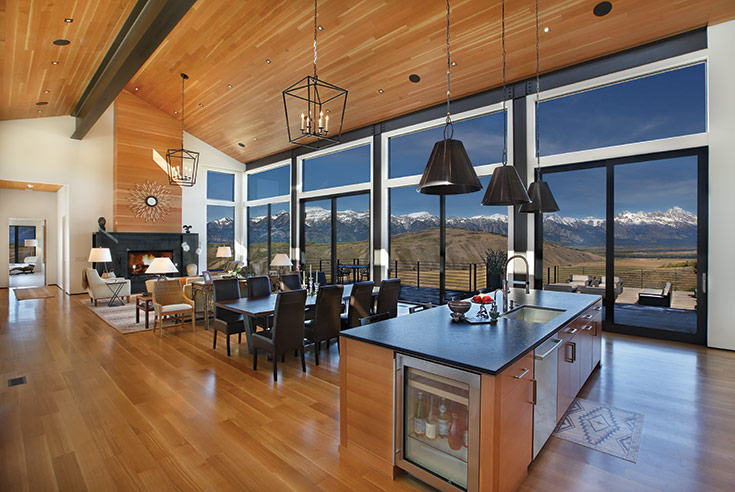
Desert-red hues from the vertical-grain fir ceilings and white oak floors create warmth in winter and a contrast to the structural steel and the wall of windows, which feature white peaks and sage foothills.

The open floor plan exposes steel and celebrates the simplicity of the structure. The windows are oriented to capture views of the Tetons and sunsets—and to protect the interior from baking in the sun.

“Having the hills in the foreground gives perspective to the mountains and the valley floor,” says the firm’s founder, Larry Berlin. “It’s almost like a painting.”

The downstairs workout room and a cozy TV nook off the open kitchen/dining/living room are two of the only places to sit without facing a window. Clerestory windows recessed above a lower roof were chosen for the south side of the house to create a more inward-feeling space. Artwork is also minimal with paintings of Mount Moran and the Grand Cathedral on the only walls in the living area, speaking to the play of light on the mountains. Sunsets filter in from the windows above, providing gentle evening light onto the extensive north-facing patio.

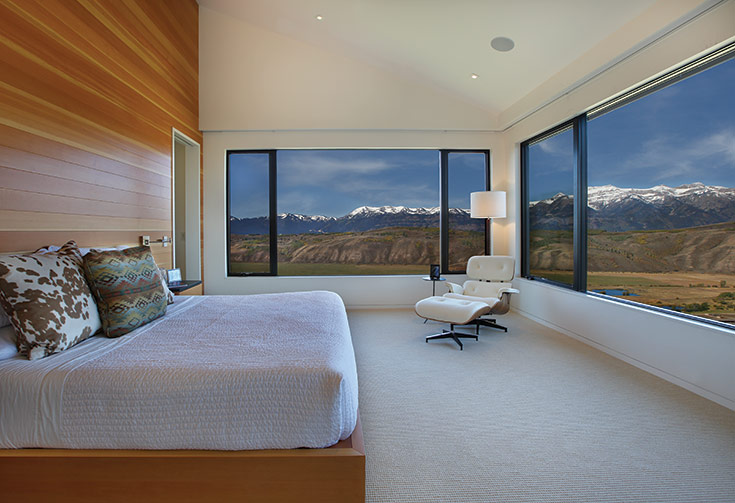
In the twin master and junior master bedrooms, seamless, vertical-grain fir walls show the architect’s precision and draw the eye to the 90-degree windows, which offer two very different mountain views.

“The house was definitely designed around the views,” Berlin says. “The windows in each bedroom meet at 90-degree angles, joining two very different mountain scenes.” A view of the southernmost peak, Mount Glory, from the master bathroom’s west window inspires a more singular perspective than the broader views of the Teton Range from the other windows. Below, the junior master suite is a mirror image of the master.
We try not to design from the outside in, but from the inside out, to make our clients’ houses very personal to them.
— Larry Berlin

All of the downstairs bedrooms have private patios, with the exception of the kids’ room. The walls above the headboards and all of the furniture in the bedrooms are made of vertical-grain fir that matches up with an architect’s precision.

“We try not to design from the outside in, but from the inside out, to make our clients’ houses very personal to them,” Berlin says.
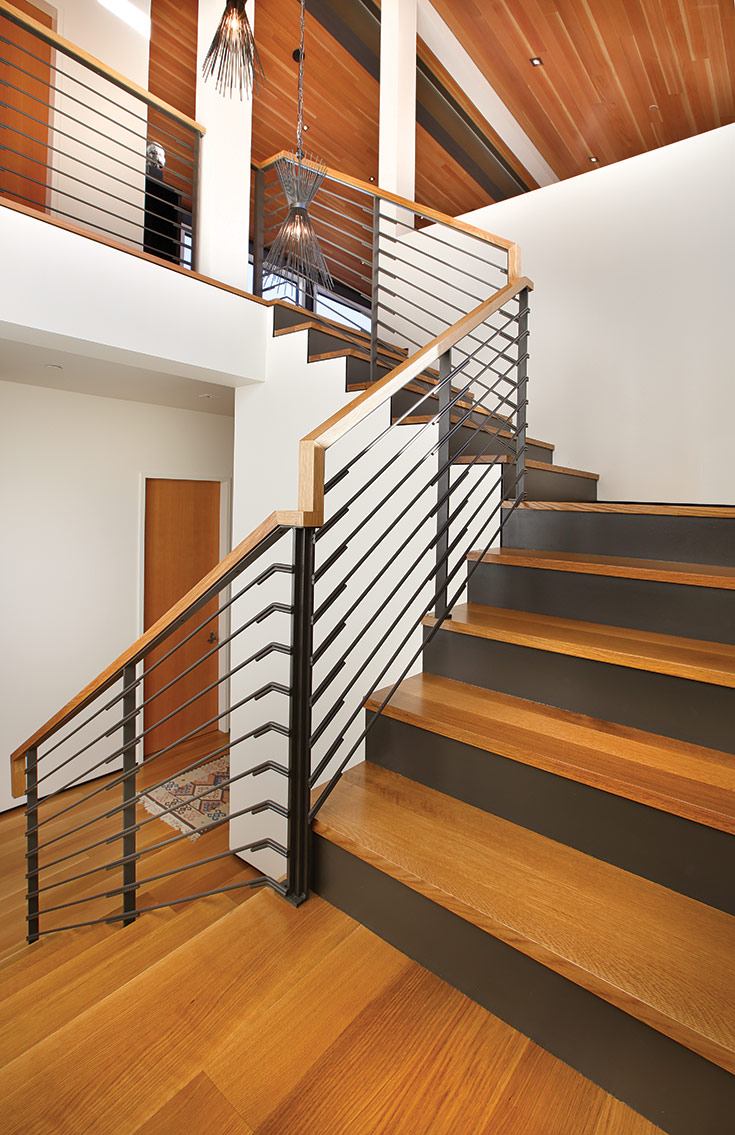
The steel-and-fir stairwell is lit by a clerestory window, which filters natural light from the south side of the house down from above the roofline.