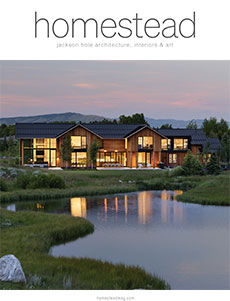

When WRJ Design principals discovered a log cabin beneath the siding of their newly purchased home, what ensued was a remodel challenge, which tied them to the history of Jackson Hole and Grand Teton National Park. The solution was realized with the help of both Ankeny Architecture and Design, and Jackson Contractors.
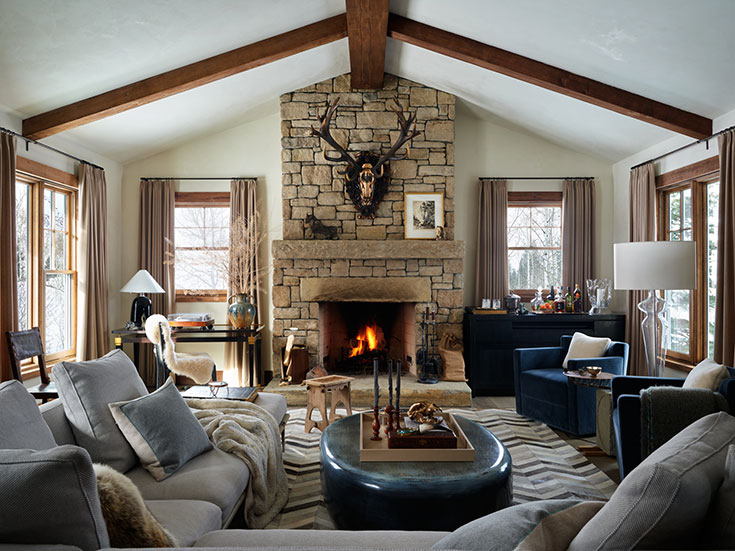
The great room was not only expanded, but the ceiling, which had been flat, was vaulted, and a stone fireplace added to anchor the room. Finishing touches included a Poltrana Frau sofa, a Holly Hunt table, Jiun Ho chairs, and an 1890 stag mount, which once belonged to Kaiser Wilhelm II.
Story
Zachary Barnett
Photos
Roger Davies
INTERIOR DESIGN
WRJ Design
wrjdesign.com
ARCHITECTURE
Ankeny Architecture and Design
ankenyarchitecture.com
CONSTRUCTION
Jackson Contractors
daniel@jackson.contractors
But then the park and Rockefeller had a log cabin problem: the land he’d amassed held a collection of old hunting residences that needed to be removed. He solved this by sending most of these structures to the campgrounds at Colter Bay, and the rest he offered up to the people of Jackson Hole.
And this is where the history lesson concludes and our story begins, with a note regarding one such cabin that found its way into town, which read:
“Klaus and Rush, Louise didn’t know the history of the cabin which was discovered in 1963 when the Hirschs added onto the garage … Louise had never heard that the cabin was moved from the former town of Moran although her father had told me it had ….”
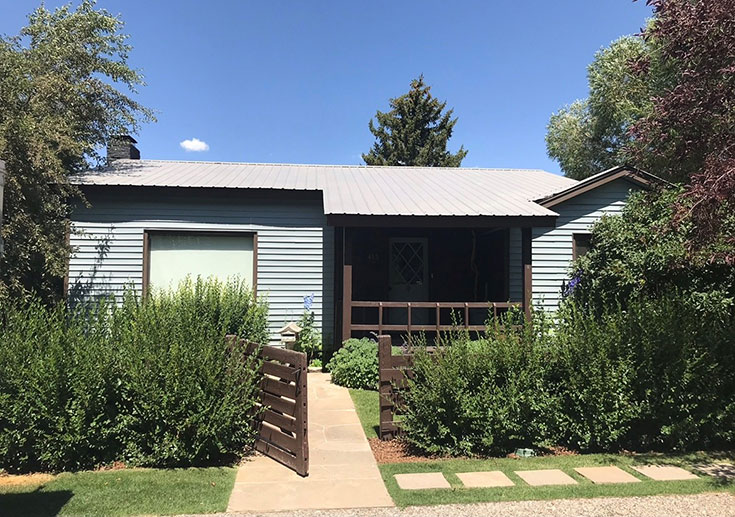
Beneath the vinyl siding of the newly purchased ranch-style home at 415 Deloney, there existed a log cabin. And this note from a neighbor to the new homeowners, WRJ Design principals Klaus Baer and Rush Jenkins, was how they came to learn of the matter.
There had been plans for a remodel. Baer wanted a new kitchen, and Jenkins, a more fitting space for his beloved Steinway. And both men wanted a more dynamic entranceway and a sunroom to replace the back patio. For five years, they waited and pondered this predicament until, in 2020, in the quiet of Covid, they reached out to their like-minded aesthete and friend, architect Shawn Ankeny, of Ankeny Architecture and Design, who they’d enjoyed collaborating with on several previous projects.
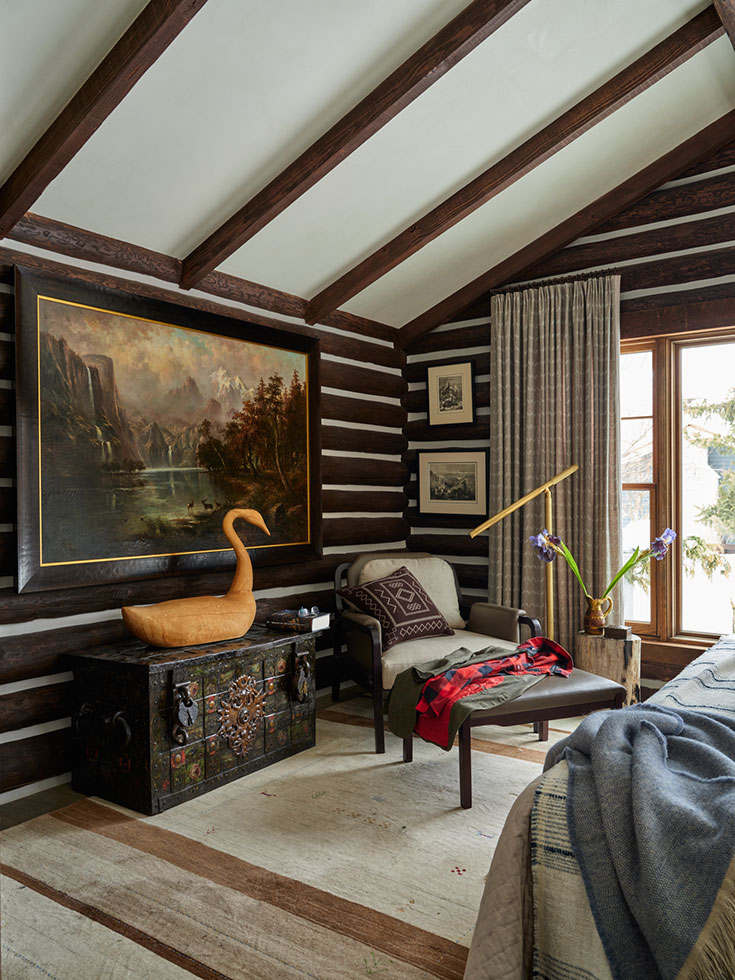
After Ankeny and Hierro restored the original ceiling pitch of the cabin and brought in paned windows to reflect its history, Jenkins and Baer turned it into their bedroom. Here treasures from times past accentuate the rich history of the structure; a late-nineteenth-century painting from the Bierstadt School, a swan from the collection of Geoffrey Beene on top of a 1690 German strongbox, prints by Thomas Moran, and a rug acquired while traveling in Cappadocia highlight Jenkins’s and Baer’s eye for collecting.
“Klaus and I both hold a deep appreciation for history, for items with rich story and meaning, and the resurrection of this little cabin became a matter of personal responsibility for us.”
— Rush Jenkins
For a contractor, they brought in Daniel Hierro of Jackson Contractors, who they’d discovered fortuitously earlier that year. Hierro offered boundless skill sets, an easy demeanor, and a great team. Together, they began discussing the possibilities.
The first line of business was, what about this mysterious cabin? Was it salvageable? The time had arrived for them to take a peek beneath the siding. Fortunately, Hierro had worked on log cabins and knew what to look for, and what they found was a treasure worth preserving.
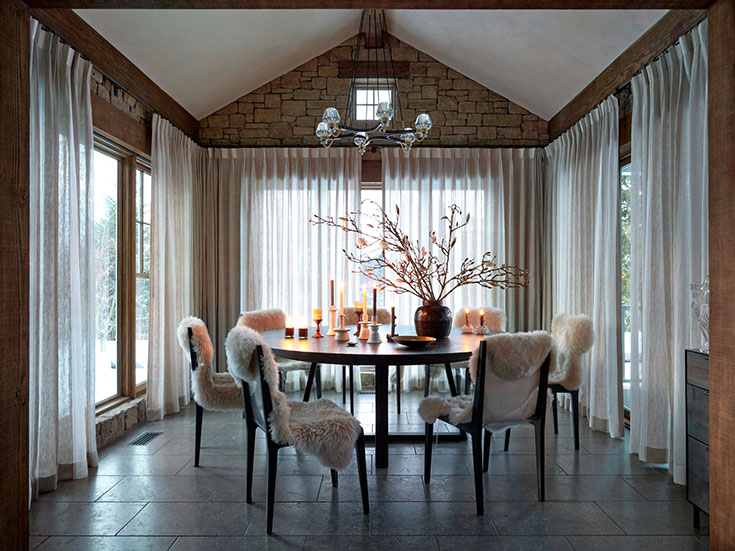
The vaulted ceiling with a clerestory window and surrounding nearly-floor-to-ceiling windows allow maximum light while providing guests the opportunity to fully experience Baer’s landscaping genius. A staple of Jenkins’s design principles is the round table, promoting conversation and inclusion. Drapes are Loro Piana linen, and the chandelier is by Jonathan Browning.
“Klaus and I both hold a deep appreciation for history, for items with rich story and meaning,” recounts Jenkins. “And the resurrection of this little cabin became a matter of personal responsibility for us.”
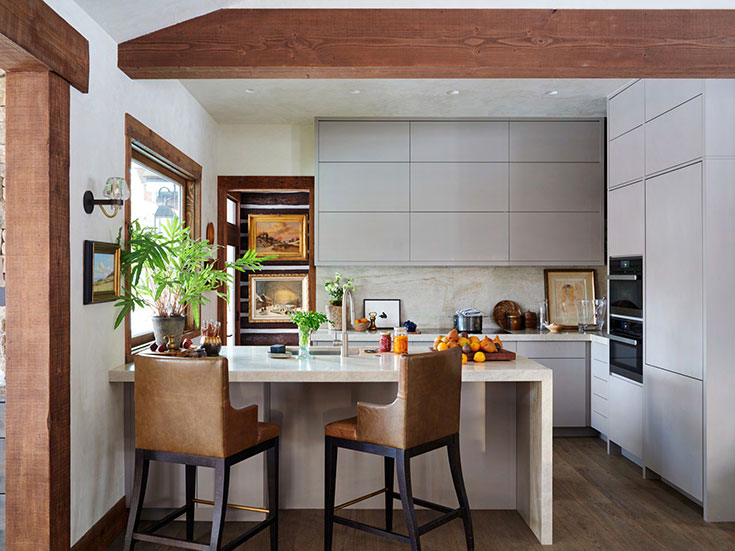
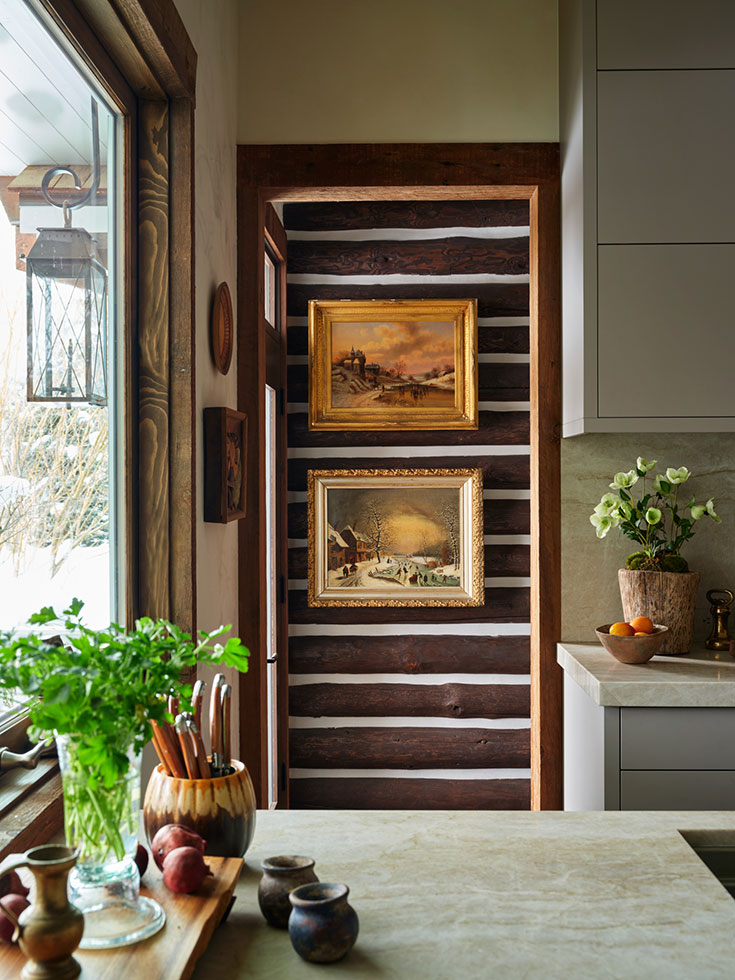
Old and new. The sleek lines of Earth Elements cabinetry, Bolier stools, and Jonathan Browning sconces contrast playfully with the exposed cabin beyond, while the large awning window to the left can open outward allowing chef Baer to serve guests on the heated patio. The paintings are from the collection of Olympic ice skater Dick Button.
Indeed, Jenkins’s design philosophy has long emphasized the value of enriching one’s home with story, whether in the form of family heirlooms or treasures of a personal nature. His training at Sotheby’s in New York had only reinforced what he’d come to believe as the son of a long line of Idaho ranchers and farmers: the true value of things lies in their meaning.
And so, with the decision made to keep the cabin, the team went into action, driving around town studying other such historic structures, the proper care of the logs and chinking, and imagining the possibilities.
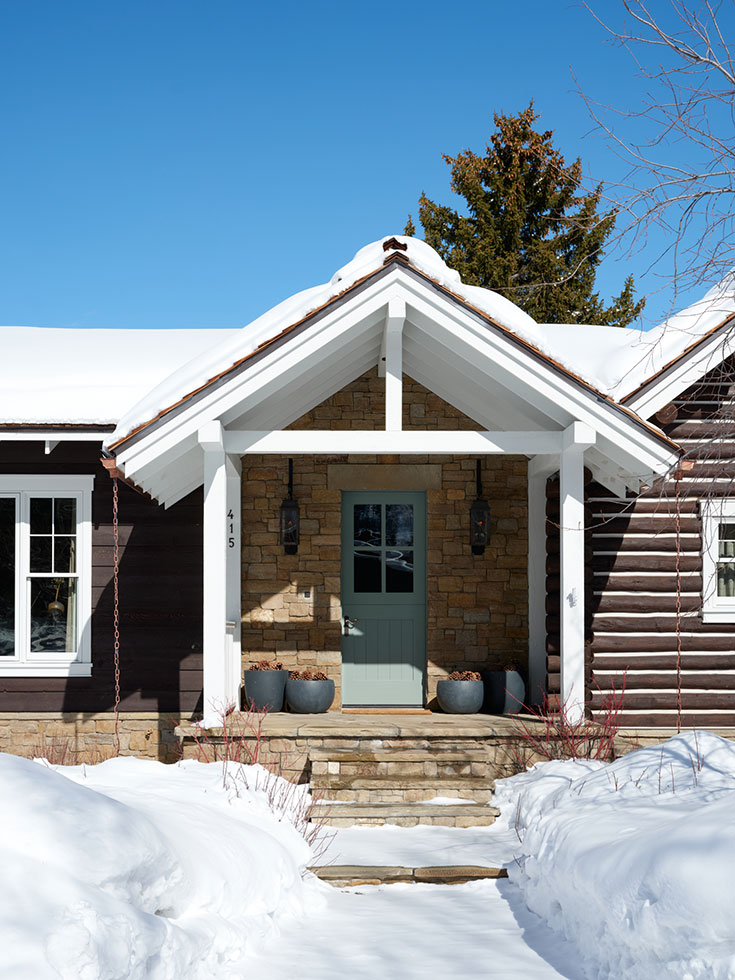
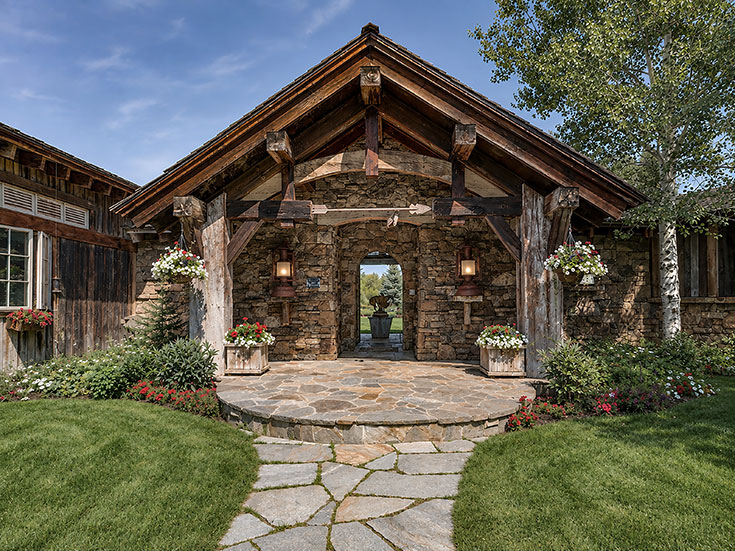
A Dutch door, copper gas lanterns by Bevolo, stonework and a stone lintel pay homage to a time gone by in Ankeny’s brilliant reimagining of the entranceway. The exposed logs, white window trim, and matching exterior coloring to the left are inspired by other such historical structures in Jackson. Compare this with the snapshot of the original house, a cacaphony of roof heights and 1950s vinyl siding.
“This project was always evolving,” remembers Ankeny. “First, liberating the cabin, then figuring out how to mesh the pitches of the roofs, removing walls to improve the flow. So many times, a solution would present itself that could make the house more gracious, and so we’d change course right there. Daniel and his team were great with that.”
Beams were removed and ceilings raised. On one end, the house was lengthened, and on the other, a proper stone garage was added. And in a stroke of high art, Ankeny and Hierro created a three-sided sunroom experience with floor-to-ceiling windows that fully embraced Jenkins’s vision and allowed both his training as a landscape architect and Baer’s expertise as a gardener to shine through.
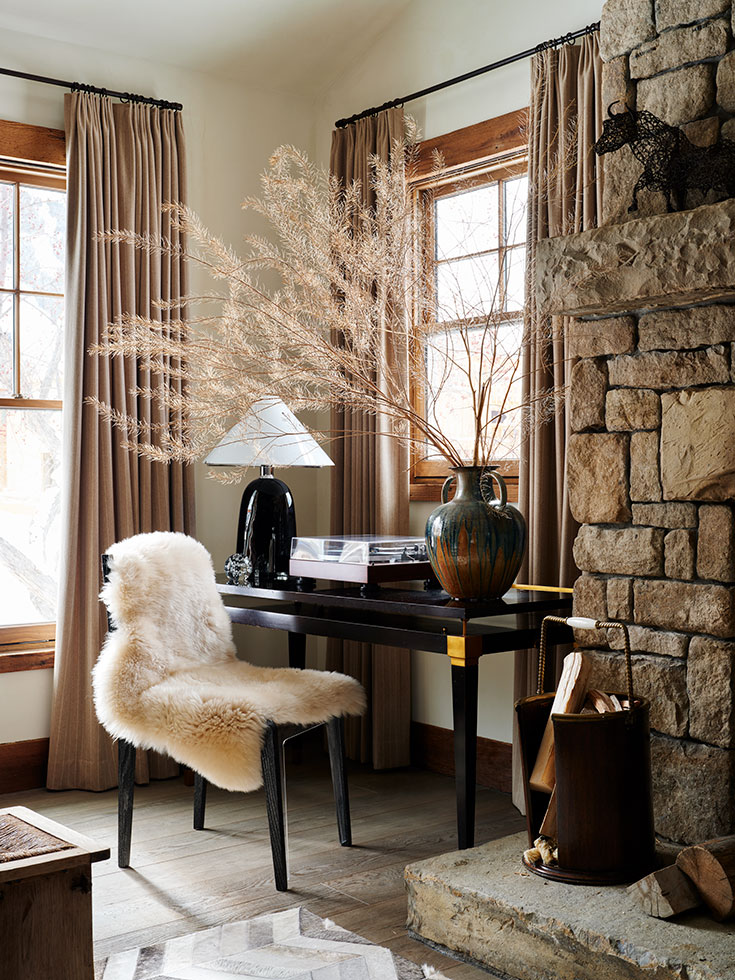
A stone mantelpiece and paned windows carry the theme of the house’s historical relevance, which is complimented here by Loro Piana cashmere drapes, an Andre Arbus desk, and a Carlo Moretti lamp.
“With the sunroom completed, we seized the opportunity to landscape this beautiful new footpath through spruce trees, hosta, and ferns, winding from the backyard to a whole new fence and garden area. It all felt very much like home,” says Baer.
Recalls Hierro, “I think in the end, we moved or removed all but two walls, and I enjoyed the process. I think what was most satisfying was that, no matter the situation, Rush and Klaus were always choosing in favor of what was most beautiful. The house spoke, and we answered.”
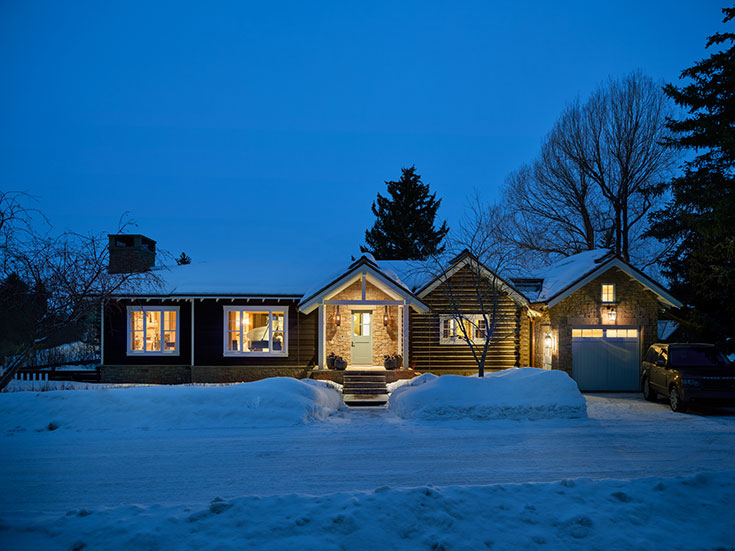
Pitch perfect. A stone garage and stone chimney bracket Ankeny’s revision, while the pitches of the roofs have been artfully meshed. The great room has been extended to the left allowing Jenkins’s piano room to breathe.